SMS Marketing Strategy: How to Build a Plan That Drives Real ResultsView as Markdown
An effective SMS marketing strategy covers goals, list building, message mix, automation, segmentation, and optimization. Here is how to build one that drives real results for your business.
- An SMS marketing strategy is a documented plan for how you grow your list, message subscribers, and measure results, not a series of one-off sends.
- The core steps are: set clear goals, build a compliant opt-in list, plan your message mix, automate workflows, segment your audience, time your sends, and measure and optimize.
- Clear consent and an easy opt-out are the compliance foundation every SMS strategy is built on.
- Businesses using EZ Texting can automate, segment, and track their entire SMS program from one platform.
What Is an SMS Marketing Strategy?
An SMS marketing strategy is a planned, documented approach to sending promotional, conversational, and transactional text messages to opted-in subscribers. The strategy defines the goals of the program, the types of messages that will be sent, the audience segments that will receive each message type, the automation workflows that will run in the background, and the metrics that will be used to evaluate and improve these marketing campaigns’ performance over time.
A promotional SMS strategy is primarily focused on generating revenue through offers, discounts, product launches, and time-sensitive campaigns, while a transactional SMS strategy is focused on delivering operational information that improves the customer experience. The most effective programs integrate both rather than focusing exclusively on one style.
A well-developed SMS marketing strategy enhances the overall marketing goals of the business, using text messaging to complement and reinforce email, social media, and in-store interactions, and vice versa.
A strong SMS strategy is not about sending more texts, it is about sending the right message to the right person at the right time.
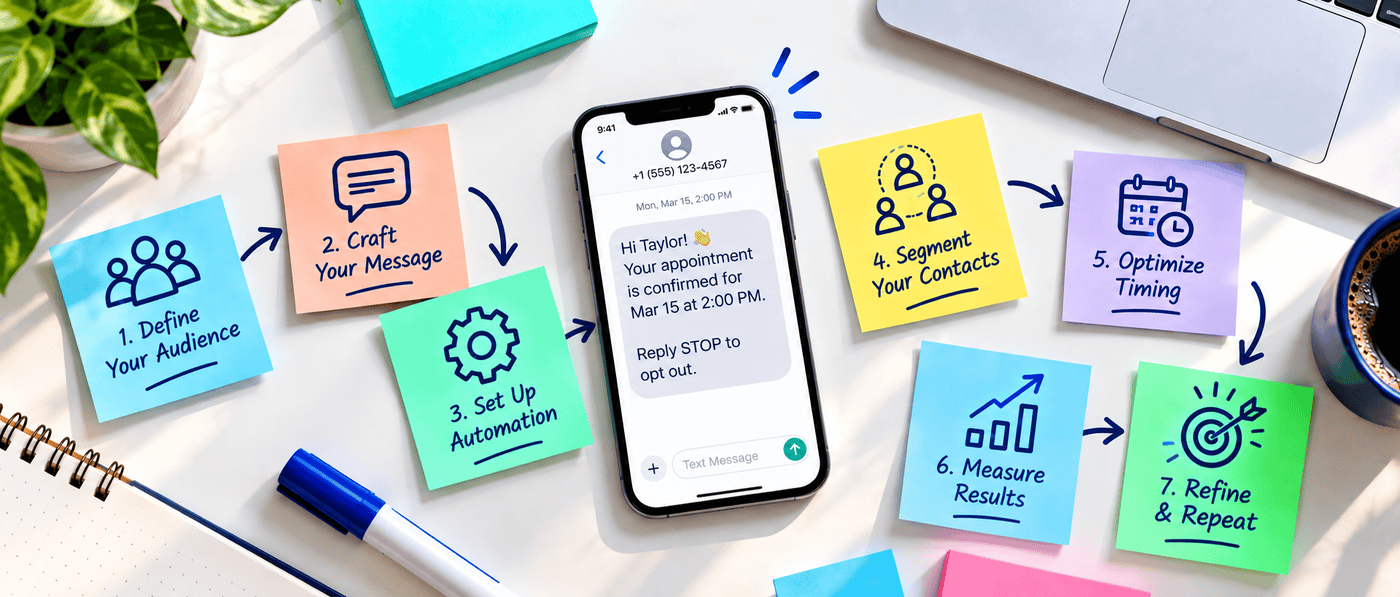
Why Having an SMS Marketing Strategy Matters
SMS subscribers are among your most engaged customers. Someone handing over their personal phone number signals a higher level of intent and brand interest than subscribing to email. It’s essential to develop a strategy that rewards this trust with relevant, valuable communication rather than generic “salesy” texts (especially when sent too often).
Data shows that 72% of SMS subscribers expect to receive text messages at least once a week from brands they follow, and 86% of people made two or more purchases based on SMS offers in the past year. A consistent, value-driven SMS strategy directly influences repeat purchase behavior and retains valuable customers.
More than any other marketing avenue, SMS thrives on immediacy, with 65% of subscribers who made an SMS-prompted purchase saying they bought the item earlier than planned because of a promotional text. A well-timed SMS strategy accelerates the purchase cycle in a way that email and social media cannot reliably replicate.
Let’s go over the key steps for developing an SMS marketing strategy.
Step 1: Define Your SMS Marketing Goals
Defining your specific goals before launching or formalizing your SMS marketing program is the most important strategic step. It determines every downstream decision including the types of messages to prioritize, the audience segments to target, the automation workflows to include, and the metrics to track after every campaign.
Common SMS marketing goals to consider include driving repeat purchases through promotional campaigns, reducing no-shows through appointment reminder automation, recovering abandoned cart revenue, increasing loyalty program engagement, growing your opt-in subscriber list, and improving customer satisfaction through post-purchase follow-ups.
Step 2: Build a Compliant Subscriber List
Building a quality, fully opted-in subscriber list is absolutely foundational to effective SMS marketing. There are no shortcuts here, as federal law requires that any business sending marketing texts obtain explicit written consent from each subscriber. Start with establishing a robust compliance foundation before collecting any phone numbers, including updating your privacy policy to describe the SMS program, learning the basics for sending compliant messages, and developing your plans for obtaining this explicit opt-in consent (which is separate from email consent or merely a list of customer phone numbers).
Opt-In Collection Strategies
The most effective opt-in consent collection strategies include:
- Website pop-ups on high-traffic pages
- Checkout opt-ins during the purchase process
- Loyalty program enrollment
- In-store QR codes on signage and receipts
- Targeted email campaigns that invite existing subscribers to join the SMS program with an exclusive incentive
- Keyword opt-in
This last strategy, where customers text a specific keyword or short phrase to your business phone number or other short code to give you permission to send them marketing text messages, has been shown to be the most effective generally, and creates the least friction.
Offering an immediate reward such as a discount code, early access, or exclusive content at the point of opt-in significantly increases sign-up rates and gives new subscribers a compelling first reason to stay engaged with the program.
Maintaining List Health
Ongoing list maintenance is as important as list growth for long-term SMS marketing strategy performance. Regularly auditing and removing inactive contacts, honoring opt-outs immediately, and monitoring deliverability rates keeps engagement metrics accurate and prevents carrier filtering issues that can reduce reach for the entire program.
Step 3: Define Your Message Mix
Most effective SMS marketing strategies draw from three core message types that serve different communication goals.
Promotional Messages
Promotional messages encourage purchases through things like sales announcements, flash sales, discount codes, product launches, exclusive member offers, and re-engagement campaigns. They perform best when targeted to a relevant audience segment and include a single, clear call to action with a direct link to the relevant page.
For best results, promotional messages should make up no more than half of total SMS sends to avoid customer fatigue.
Transactional Messages
Transactional messages include order confirmations, shipping updates, appointment reminders, and delivery notifications. They produce the highest open and engagement rates because recipients are expecting them and are motivated to read them immediately. Many transactional messages can be automated, reducing both operational workload and the inbound support inquiries that occur when customers cannot find the status information they want.
Conversational Messages
Conversational messages invite customers to respond, ask questions, provide feedback, or participate in other two-way exchanges that make the relationship feel more personal and interactive compared to purely transactional.
Step 4: Build Your Automation Workflows
Automated messaging makes scalable SMS marketing possible. Personalized messages can be triggered by customers’ actions, scheduled dates, or defined time intervals, enabling businesses to deliver consistent, relevant communication to every subscriber without proportionally increasing manual workload as the list grows.
The highest-impact automation workflows include the welcome sequence for new subscribers, abandoned cart recovery for eCommerce businesses, appointment reminders for service businesses, post-purchase follow-ups for all business types, and re-engagement campaigns for lapsed subscribers. Let’s look at some of these briefly.
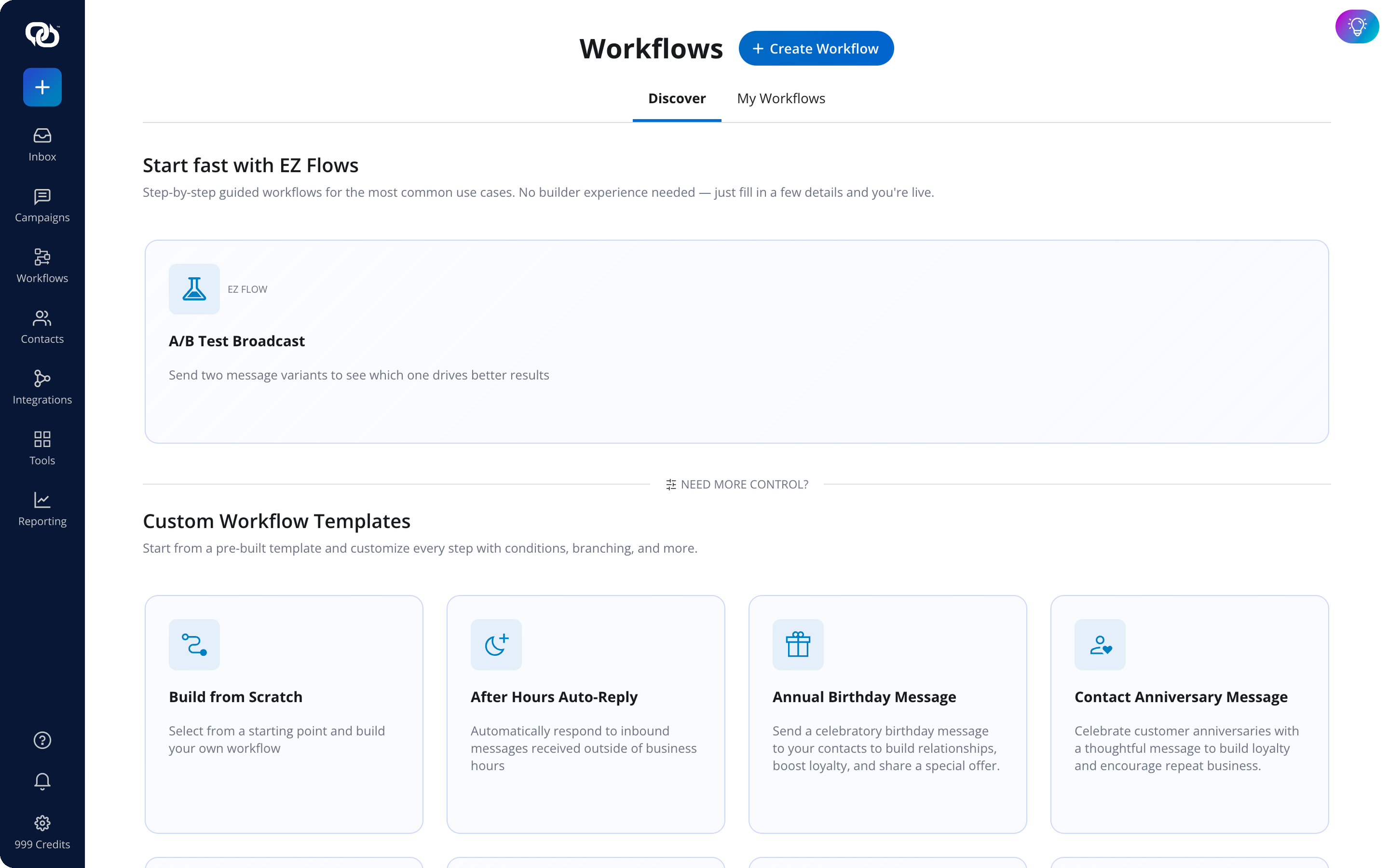
Welcome Sequence
The welcome SMS sequence is hugely important because it is the first communication every new subscriber receives. In fact, it’s the highest-read message in the entire program and your single best opportunity to demonstrate the value of being a subscriber.
An effective automated welcome sequence includes an immediate confirmation message with an incentive (such as a discount code or free item), followed by one or two additional messages spaced over the first week that introduce your brand’s value proposition, highlight key products or services, and guide the subscriber toward their first purchase or other action.
Abandoned Cart Recovery
This is one of the highest-ROI message types. When set up properly, an SMS is automatically sent when a customer has added items to their cart but left without completing the purchase, ideally within 30 to 60 minutes of abandonment. The most effective abandoned cart sequences include two to three messages, starting with a friendly reminder that references the specific product left behind and links directly to the saved cart, followed by a second message with a time-limited incentive (such as an additional discount) if the first message did not result in a purchase within a set amount of time.
Post-Purchase and Loyalty Flows
Post-purchase automation sends a sequence of messages after a customer completes a transaction, starting with order and shipping updates that build confidence in the purchase decision, and transitioning into review reminders, product recommendations, and/or loyalty program invitations that create the motivation for repeat purchases.
Loyalty program updates may include points balance notifications, tier upgrade announcements, and reward expiration reminders.
Text updates consistently drive faster redemption and stronger repeat purchase behavior than email because subscribers typically read texts immediately.
Step 5: Segment Your Audience for Targeted Campaigns
Effective audience segmentation helps your businesses stay relevant with SMS subscribers over time. If a business starts sending the same message to all contacts on the list regardless of their interests, purchase history, or engagement level, it has lost the personalization advantage that makes SMS marketing more effective than other channels.
Even basic segmentation significantly improves campaign performance. The most important foundational segments include:
- SMS-consented subscribers kept separate from email-only contacts
- Recently engaged subscribers who have interacted with messages in the past 30 days
- VIP customers who have made multiple purchases
- Lapsed subscribers who have not engaged in 60 to 90 days
Additional segmentation can be added as the subscriber list grows, demographic info becomes available, and campaign data accumulates. A segmentation strategy may include location-based segments for businesses with physical locations, purchase category segments for retailers with broad product ranges, and loyalty tier segments that deliver exclusive content or offers to the brand’s most valuable customers.
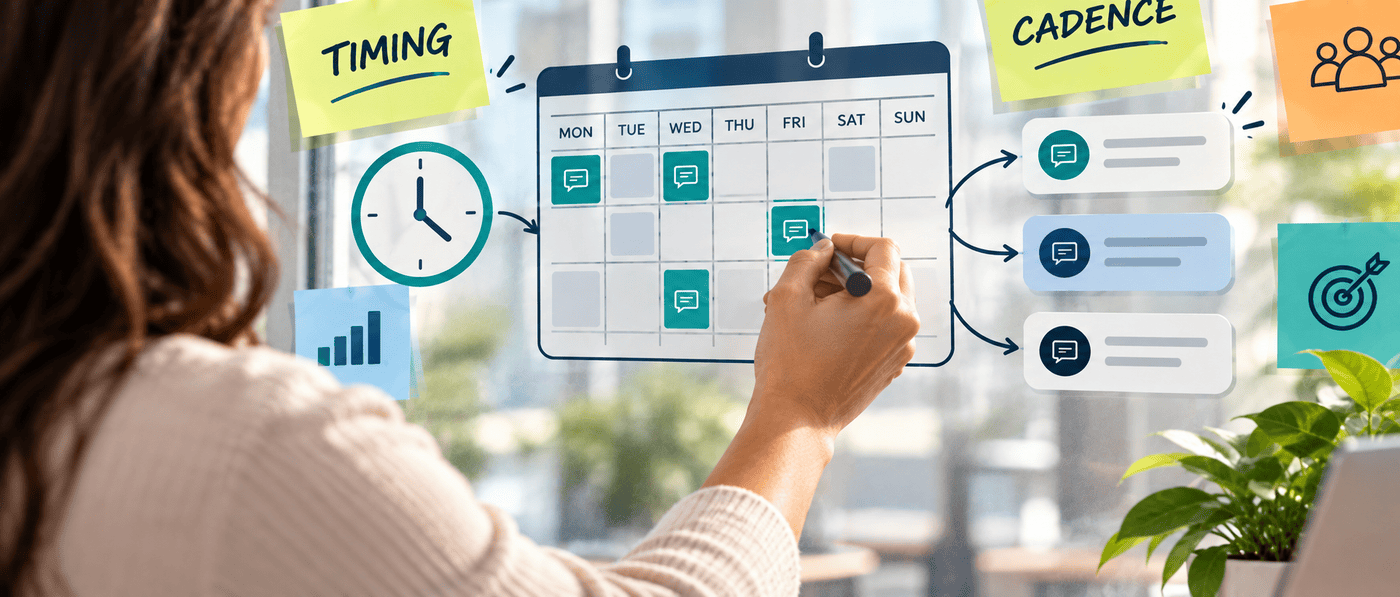
Step 6: Establish Your Send Cadence and Timing
Most small and midsize businesses find that between two and six messages per month across the full subscriber list typically helps them stay relevant while avoiding sending too many messages. This frequency can be adjusted for seasonal/holiday campaigns when subscribers might expect more activity.
The 4pm to 7pm (local time) window consistently delivers the highest revenue per send for promotional campaigns, while the 12pm to 3pm window generates the strongest click-through rates. (Note: The TCPA prohibits sends before 8am or after 9pm in the recipient’s local time zone regardless of the campaign type.)
Step 7: Measure Performance and Optimize Continuously
It’s important to measure the performance of every SMS campaign against the goals you defined in step one. This gives you the data you need to help you understand what parts of your strategy are working and where you should evolve.
At a minimum, you should track delivery rate, click-through rate, response rate, opt-out rate, revenue per send, and subscriber list growth rate. A/B testing different message formats, calls to action, send times, offer types, and MMS versus SMS formats helps improve performance, and you should incorporate this kind of testing as a regular part of your strategy.
Start Building an SMS Marketing Strategy That Works
EZ Texting’s contact management tools make it straightforward to maintain an accurate, well-organized subscriber list and track opt-out status.
EZ Texting’s two-way texting tools allow businesses to manage conversational exchanges at scale, routing customer replies to the appropriate team member or automated response flow while maintaining the personal feel that makes SMS engagement effective.
EZ Texting’s automation tools can be configured so abandoned cart recovery messages begin triggering from the first day the workflow goes live without requiring manual monitoring.
EZ Texting’s analytics dashboard lets you monitor campaign performance trends over time, compare results across different segments and message types, and apply what you learn from each send to make your next campaign more targeted and effective.
Start Your Free Trial and discover firsthand how EZ Texting helps businesses turn a simple SMS marketing idea into a structured, high-performing strategy that drives engagement, loyalty, and real revenue.
Frequently Asked Questions About SMS Marketing Strategy
Businesses can see engagement shortly after launching, but evaluating overall performance may take weeks or months. Results depend on audience size, campaign frequency, goals, and message quality.
A strategy defines long-term goals, audiences, and messaging priorities. A plan translates that strategy into specific campaigns, schedules, workflows, and performance metrics.
Review your strategy at least quarterly and whenever customer behavior, business goals, regulations, or performance trends change significantly.
Yes. Small businesses can start with a focused subscriber list, clear goals, and a few high-value campaigns, then expand based on results.
eCommerce strategies often emphasize product launches, promotions, and abandoned carts. Service businesses may prioritize appointment reminders, service updates, follow-ups, and timely offers.
Sending messages to people who haven’t specifically opted in to receive SMS marketing messages may occur when a business assumes that a list of customer phone numbers and/or email marketing consent constitutes a compliant SMS marketing audience (it doesn’t). However, the most common mistake is probably sending messages without a clear purpose or call to action. Businesses should define goals, segment audiences, provide real value, and avoid excessive messaging.
See other related to Features:
See other related to Use Cases:
See other related to Topics: