RCS Messaging Examples and Use Cases for Small BusinessesView as Markdown

RCS messaging turns standard business texts into interactive customer experiences with images, buttons, and branded profiles. See real-world examples and use cases that drive bookings, sales, and engagement.


Smartphone showing a rich RCS business message with a product carousel and Shop Now and Book Now buttons, surrounded by retail, hospitality, restaurant, healthcare, and wellness use-case images
Key Takeaways
  • RCS messaging adds interactive features like images, buttons, carousels, and branded profiles to standard business texting
  • Businesses can use RCS messaging for promotions, appointment reminders, order updates, loyalty campaigns, and customer feedback collection
  • RCS works best alongside SMS marketing by combining richer customer experiences with the broad reach and reliability of traditional text messaging
  • Small and midsize businesses already using SMS platforms like EZ Texting are well-positioned to begin experimenting with RCS campaigns

What Is RCS Messaging?

Text messaging has moved far beyond plain text updates and discount codes. Customers now expect business communication to feel faster, more visual, and easier to interact with directly from their phones. In response, RCS messaging is gaining traction with businesses of all sizes.

RCS stands for Rich Communication Services, an advanced messaging protocol designed to upgrade the traditional SMS experience. While SMS is limited to basic text, RCS messaging supports interactive and visual features directly inside a customer's default messaging app.

With RCS, businesses can send messages that include:

  • Product images and videos
  • Scrollable carousels
  • Quick reply buttons
  • Click-to-purchase actions
  • Branded business profiles with logos and verification badges

That creates a messaging experience that feels closer to a mobile app or social media interaction while still happening inside the phone's native texting interface.

One of the biggest advantages of RCS messaging is accessibility. Customers do not need to download a separate application to interact with RCS campaigns. If their device and carrier support RCS, the enhanced message experience appears automatically in their default messaging app.

RCS also supports SMS fallback. If a customer's device or carrier does not currently support RCS, the message can still be delivered as a traditional SMS text. That flexibility helps businesses expand into richer messaging experiences while maintaining the broad reach text messaging is known for.

For businesses already using SMS marketing, RCS messaging is a natural next step. EZ Texting helps businesses manage customer communication across messaging channels so campaigns continue reaching customers effectively, regardless of device compatibility.

SMS and RCS both deliver messages directly to a customer's phone, but the customer experience is very different.

RCS Messaging vs. SMS: What Is the Difference?

SMS and RCS both deliver messages directly to a customer's phone, but the customer experience is very different.

Traditional SMS is built for simple text communication. Messages are limited to 160 characters, support minimal branding, and do not include interactive features. That simplicity is part of why SMS remains so reliable and universally supported across devices and carriers.

RCS messaging expands on that foundation by adding much more interactive functionality. Branded elements and tappable buttons are better at helping customers respond or take action instantly. RCS also gives businesses deeper engagement insights: read receipts, delivery confirmations, and interaction tracking make it easier to understand how customers engage with campaigns after messages are delivered.

FeatureSMSRCS
Character support160 charactersLong-form messaging
Media supportLimitedImages, videos, carousels
BrandingNoneVerified business profiles
InteractivityBasic linksButtons and quick replies
AnalyticsLimited delivery dataRead receipts and engagement tracking
CompatibilityNearly universalDevice and carrier dependent

RCS is not a replacement for SMS. SMS still provides unmatched reach and reliability, especially for urgent communication and broad customer outreach. For many businesses, the strongest approach is combining both formats as part of a larger messaging strategy.

RCS Messaging Examples for Small and Midsize Businesses

The biggest advantage of RCS messaging is that it turns standard business texts into interactive customer experiences. Here are the most common RCS messaging examples small and midsize businesses are already exploring.
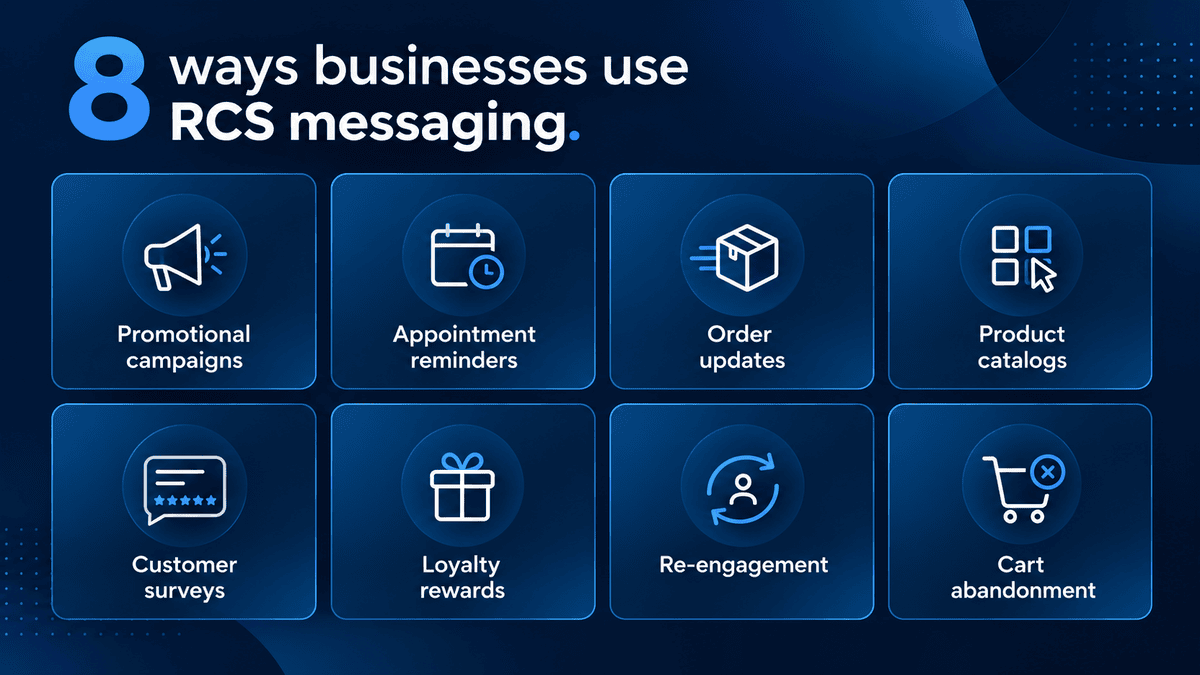
Infographic grid of eight RCS use cases: promotional campaigns, appointment reminders, order updates, product catalogs, customer surveys, loyalty rewards, re-engagement, and cart abandonment

Eight common ways small and midsize businesses put RCS messaging to work.

Promotional Campaigns

Retailers and ecommerce brands use RCS messaging to run flash sales, seasonal promotions, and product launches with far more visual impact than standard SMS. An apparel store could send a branded message featuring product images, pricing, and quick reply buttons like "Shop Now" or "View New Arrivals." Customers can browse products immediately instead of clicking through multiple pages first.

Appointment Booking and Reminders

Service-based businesses use RCS to simplify appointment management and cut down on missed bookings. A salon, dental office, or home services company can send appointment reminders with interactive buttons that let customers confirm, reschedule, or request a callback directly from the message. Some businesses also use carousel cards to display available appointment times inside the conversation itself.

Order Updates and Delivery Confirmations

RCS messaging gives ecommerce and retail businesses a more polished way to manage post-purchase communication. Instead of a plain shipping notification, businesses can send order confirmations with product images, tracking details, estimated delivery windows, and support buttons customers can tap if they have questions about their order.

Product Catalogs and Mini Storefronts

One RCS message can function like a lightweight mobile storefront. Businesses can build scrollable product carousels that showcase multiple items, pricing, descriptions, and purchase buttons in a single thread. That creates a smoother shopping experience for customers browsing directly from their phones.

Customer Feedback and Surveys

RCS messaging makes feedback collection feel faster and less tedious. Restaurants, healthcare providers, and service businesses can send post-visit surveys with star ratings, quick reply buttons, or short in-message questionnaires that customers can complete in seconds. Fewer steps often lead to stronger response rates compared to email surveys.

Loyalty Rewards and VIP Offers

Brands use RCS to deliver personalized rewards that feel more premium and interactive. A coffee shop might send loyalty members a birthday reward with branded graphics and a redeem button, while a retailer could offer early access to a limited product drop through an exclusive RCS campaign.

Re-Engagement Campaigns

Businesses can reconnect with inactive customers using personalized recommendations and time-sensitive offers. A beauty brand could send a carousel featuring products related to a customer's previous purchases, along with a limited discount button that drives them back to the site before the offer expires.

Cart Abandonment Follow-Ups

Cart recovery is one of the strongest early use cases for RCS messaging. Rather than a generic reminder text, businesses can send abandoned cart messages that include product photos, pricing, and a direct checkout button that reduces friction and encourages customers to complete the purchase quickly.

RCS Messaging Use Cases by Industry

RCS messaging is flexible enough to support a wide range of industries because it is visible and customizable, and the format is familiar to practically any consumer. Here is how different types of businesses are putting RCS messaging to work.

Retail and Ecommerce

Retail brands are using RCS messaging for:

  • Cart abandonment recovery campaigns with product images and checkout buttons
  • Back-in-stock alerts that let customers purchase immediately
  • Product catalog browsing through swipeable carousels
  • Loyalty reward delivery with branded offers and redemption links

These campaigns work especially well for mobile shoppers because customers can browse and take action directly from the message thread.

Healthcare

Healthcare providers use RCS messaging to simplify patient communication and reduce administrative friction. Interactive appointment reminders can include confirmation and rescheduling buttons, while prescription refill notifications and lab result alerts help patients stay informed without requiring a phone call. Rich messaging also gives healthcare organizations a more polished and trustworthy communication experience.

Restaurants and Food Service

Restaurants use RCS to drive faster ordering and stronger customer engagement. Common use cases include daily specials with food images, reservation confirmations, online ordering prompts, loyalty rewards, and waitlist status updates. Interactive buttons make it easier for customers to place orders or reserve tables in just a few taps.

Nonprofits and Community Organizations

Nonprofits can use RCS messaging to make fundraising and event communication more engaging. Campaigns may include donation buttons, volunteer sign-up prompts, event invitations with RSVP functionality, and branded storytelling visuals that help organizations connect emotionally with supporters directly through mobile messaging.

Franchise and Multi-Location Businesses

Franchise businesses often need localized communication across different markets. RCS messaging supports region-specific promotions, operational updates, satisfaction surveys, and location-based campaigns that feel more personalized to the recipient while still being managed at scale.

Service Businesses

Home services companies, salons, fitness studios, and professional service providers use RCS messaging to reinforce professionalism throughout the customer experience. Businesses can send quote confirmations, appointment reminders, job completion updates, payment links, and follow-up review requests through branded messages that look more polished than standard text communication.

Why RCS Messaging Drives Stronger Results Than SMS Alone

RCS messaging is gaining traction because businesses are seeing performance improvements compared to traditional messaging campaigns.
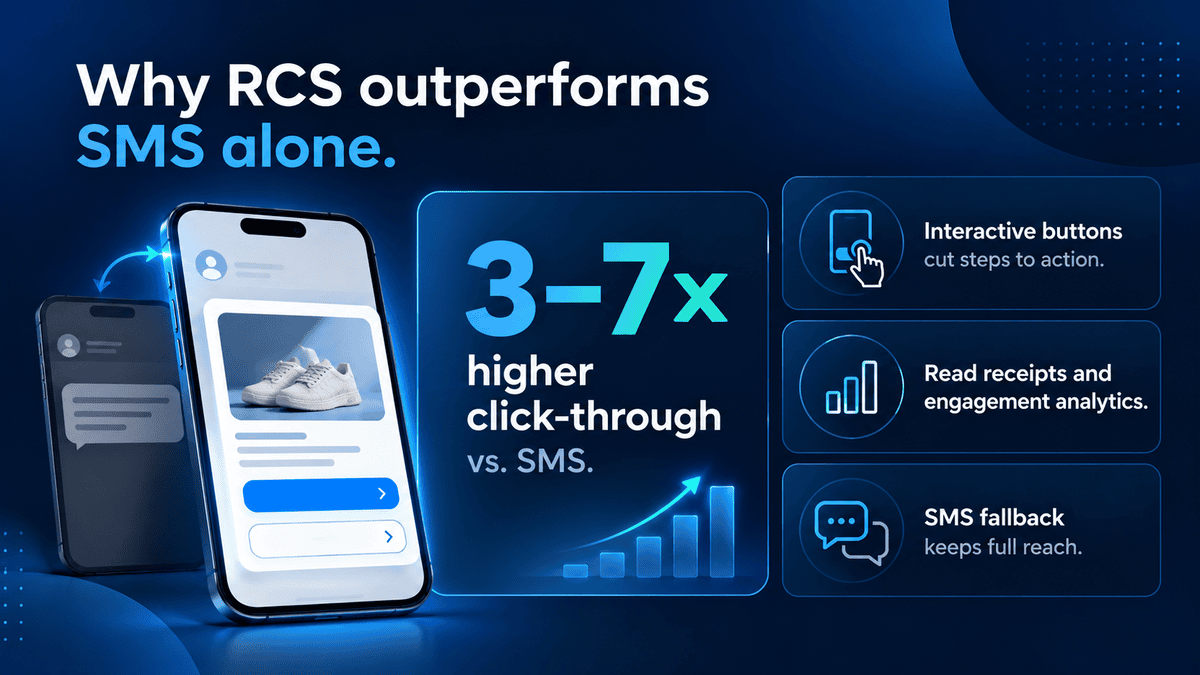
Infographic: RCS delivers 3 to 7 times higher click-through than SMS, with interactive buttons, read receipts and analytics, and SMS fallback

RCS can drive far higher click-through than SMS alone, with analytics and SMS fallback built in.

Published RCS click-through benchmarks are encouraging but should be treated as directional. The figures currently in circulation come from messaging vendors rather than independent research, and they vary widely from one provider to the next. The reliable way to size the opportunity for your own business is to run an RCS campaign against a comparable SMS send to the same audience and measure the difference yourself.

Where the lift does show up, it usually comes from reducing the number of steps customers need to take. A customer can browse products, tap a quick reply button, confirm an appointment, or complete a purchase directly from the message thread instead of navigating across multiple pages and apps.

RCS is also arriving at the right moment for business messaging adoption. Apple's support for RCS on iPhone has expanded the potential audience significantly, giving businesses better access to rich messaging experiences across both Android and iPhone devices.

Businesses also gain more visibility into campaign performance. Unlike standard SMS, RCS supports read receipts, interaction tracking, and richer engagement analytics that help marketers understand what customers actually do after opening a message.

For small and midsize businesses, the strongest strategy is rarely choosing between SMS and RCS. SMS continues to provide broad reach and reliability, while RCS creates more immersive customer experiences where supported.

RCS Messaging Best Practices for Businesses

Strong RCS campaigns still follow the same fundamentals as effective SMS marketing: clear messaging, relevant timing, and a focused call to action.

Keep the Message Focused

Rich media should strengthen the message instead of competing with it. A customer should immediately understand what the business wants them to do after opening the message.

A restaurant promoting a weekend special may only need one strong food image and a "Reserve Now" button to drive action. A retailer launching a new collection might benefit from a carousel that lets customers browse multiple featured products directly inside the message thread. The more complicated the experience becomes, the easier it is for customers to disengage before taking action.

Build Campaigns With SMS Fallback in Mind

Not every device or carrier currently supports RCS messaging. Businesses should always structure campaigns so customers can still receive a standard SMS version when RCS is unavailable.

That fallback strategy is important for maintaining reach, especially for appointment reminders, order updates, and other operational communication where message delivery matters more than visual presentation. Businesses already using SMS marketing through EZ Texting are in a strong position to test RCS messaging gradually while still maintaining reliable delivery across their broader audience.

Match Message Timing to Customer Behavior

Timing has a major impact on engagement rates across both SMS and RCS campaigns. Retail promotions tied to product launches or flash sales tend to perform best during high shopping activity windows, while appointment reminders are most effective close enough to the scheduled visit to remain useful without becoming disruptive.

Because RCS messages are often more visual and interactive, poor timing can feel even more intrusive than a standard text campaign. Businesses should pay close attention to customer behavior patterns and send frequency as they build their messaging cadence.

Prioritize Consent and Customer Trust

RCS messaging does not change the compliance expectations tied to business texting. Businesses still need explicit customer opt-ins before sending marketing campaigns and must process opt-out requests immediately.

Verified sender profiles can help businesses appear more trustworthy, but long-term engagement still depends on respecting customer preferences and delivering relevant communication consistently. That is especially important as customers become more selective about which brands they interact with through mobile messaging.

Test Formats and Review Engagement Data

One of the biggest advantages of RCS messaging is the ability to experiment with different formats and interaction styles. Some audiences may respond best to single-image promotional campaigns with one clear call to action, while others engage more with carousel browsing experiences, quick reply buttons, or interactive survey flows.

Businesses should review read receipts, button taps, conversions, and opt-out trends after every campaign to identify what messaging formats produce the strongest results. Small adjustments to visuals, layouts, and button wording can have a meaningful impact on engagement over time.

How EZ Texting Helps Businesses Get Started With RCS Messaging

Adopting new messaging channels can feel complicated for small businesses, especially when customer data, compliance, campaign management, and analytics are all part of the process.

EZ Texting

EZ Texting helps businesses manage customer communication through tools designed for scalable messaging without a complicated setup process.
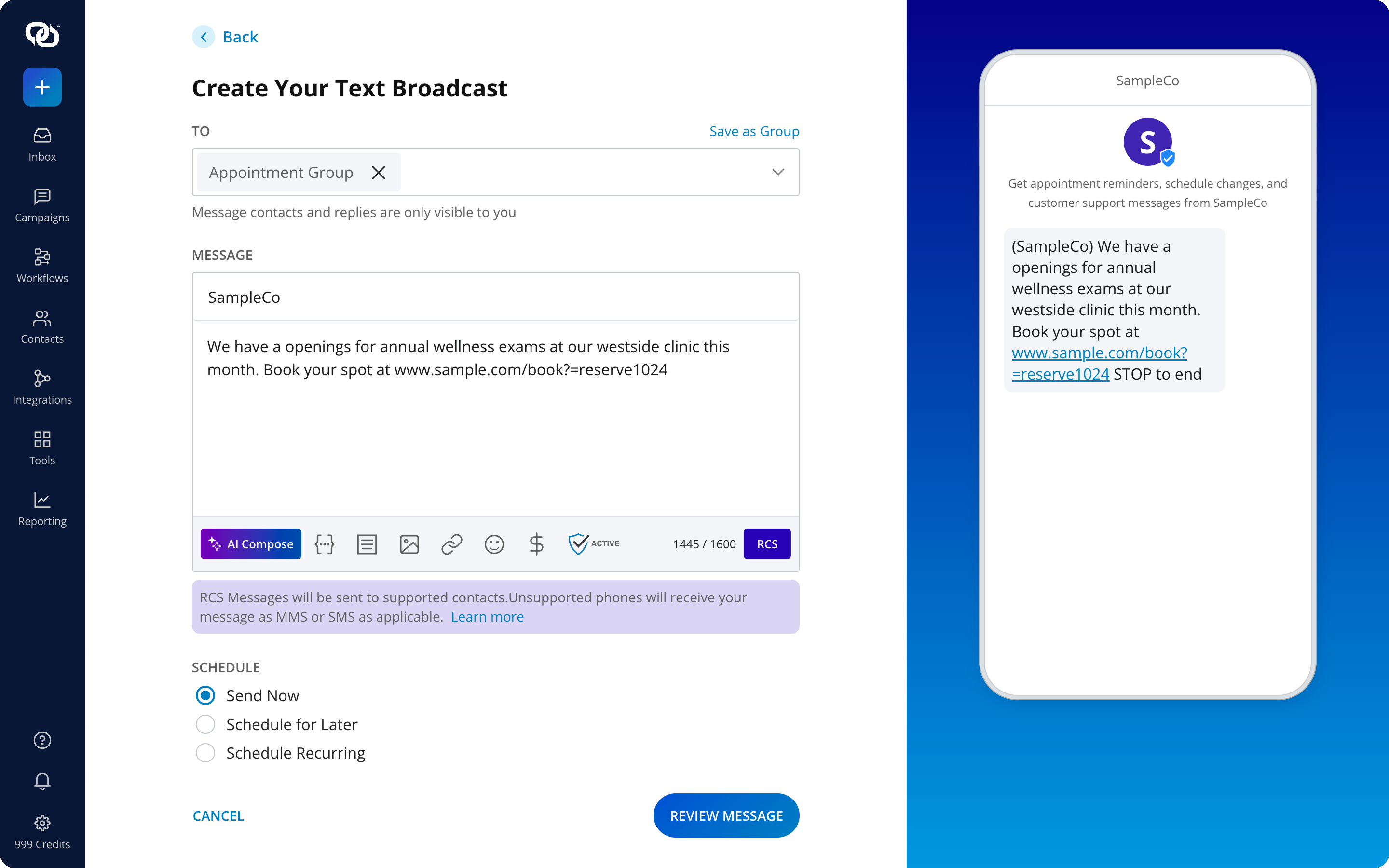
EZ Texting Create Your Text Broadcast composer with recipients, message, image, and send or schedule options

Build and send rich messages to your whole contact list from the EZ Texting composer.

Businesses already using EZ Texting for SMS marketing are well-positioned to explore RCS messaging as adoption grows. Features like bulk texting, MMS campaigns, automation, segmentation, and analytics already support many of the same strategies businesses use for richer messaging campaigns.

That means a retailer running SMS promotions today can expand into interactive product showcases tomorrow, while a healthcare provider using automated reminders can build more engaging booking experiences as RCS support continues to expand. EZ Texting also helps businesses organize contacts, segment audiences, monitor campaign performance, and improve messaging strategy over time as customer communication evolves across both SMS and emerging channels.

Start Reaching Customers With Richer, More Engaging Messages

EZ Texting

EZ Texting gives small and midsize businesses the tools to build those experiences through scalable SMS marketing, automation, audience segmentation, analytics, and emerging messaging capabilities like RCS.

Start a free trial and explore how richer messaging campaigns can help drive more engagement, stronger customer communication, and faster action from the audiences that matter most.

Frequently Asked Questions About RCS Messaging Examples

A strong RCS message does not need elaborate production. In many cases, a single product image, a short message, and one clear call to action button create a far more engaging experience than standard SMS alone. Platforms like EZ Texting help businesses build professional messaging campaigns without needing a dedicated design team.

Promotional campaigns and appointment reminders are often the easiest starting points. Both are straightforward to execute and give businesses measurable outcomes like increased bookings, fewer no-shows, and stronger offer redemption rates.

Yes. Small businesses can use the same core RCS features, including carousels, branded sender profiles, and quick reply buttons. Many businesses start with a focused audience segment and one highly relevant offer before expanding into more advanced campaigns.

The easiest approach is upgrading campaigns that already perform well. A plain text promotional message can become a richer experience by adding a product image, a branded sender profile, and a tappable call to action button.

Retail, restaurants, healthcare organizations, nonprofits, and service businesses are among the strongest early adopters because RCS supports visual promotions, appointment management, customer engagement, and interactive communication in one message thread.

RCS campaign frequency should follow the same principles as SMS marketing. Consistency matters more than volume. Many businesses start with one or two campaigns per month and adjust based on engagement rates, opt-outs, and customer response patterns.

14-DAY FREE TRIAL
Take EZ Texting for a Spin
The easiest way to add SMS to your business. No credit card required.
1,000+ five-star reviews

Join the 230,000+ Who Have Used EZ Texting to Connect with Their Audiences.