Personalization in Political Texting: The Power of a Personal TouchView as Markdown
Find out how personalized political text messages can help improve voter engagement.
- Personalization is what makes a political text land; it turns a mass blast into a message a voter actually reads and acts on.
- Texts reach voters fast: SMS sees a 98% open rate versus 18% for email, so pair texting with your other outreach rather than replacing it.
- Use voter data, micro-targeting, dynamic fields, and two-way replies to tailor messages by name, location, issue, and past behavior.
- Match the message to the moment: personalized calls to action, invitations, and Election Day reminders each drive a specific voter action.
- Track open, click-through, and response rates alongside donations and turnout, and compare against a control group to prove what works.
- Stay compliant with the TCPA and CAN-SPAM: get express written consent, identify your campaign, and always offer an opt-out.
Personalization in Political Texting
When you build a political campaign communication plan, an SMS strategy belongs at the center of it. Texts reach voters faster and more reliably than almost any other channel, including email.
The numbers make the case. SMS messages see a 98% open rate, and 70% of texts are opened within five minutes. Email marketing lands an 18% open rate, and just 19% of those emails are opened on arrival.
Email, social, and in-person outreach still matter. Texting works best alongside them, reaching voters on the device they check most.
The texts that actually land feel personal. Personalization is what turns a mass blast into a message a voter reads and acts on.
A generic text reaches a phone. A personal one reaches a person.
Understanding Political Text Messaging
Political text messages are SMS messages sent to voters and potential voters. They share information about candidates and parties, and they also carry the practical details voters need: registration deadlines, Election Day reminders, polling locations, volunteer shifts, campaign events, and donation links. A good political text can inspire, educate, and move someone to act.
Personalization is what makes those texts stand out. It catches a voter's attention and invites a reply, so your message gets read instead of deleted.
Why personalization matters
Personalization works because it signals that you understand the voter. That understanding drives deeper engagement and higher response rates. A personalized text can reference the issues a voter cares about, name events happening in their region, and, at a minimum, use their first name.
It also shows effort. Taking the time to tailor a message tells a voter you have done your homework, and that builds the trust a campaign runs on.
Why generic texts fall short
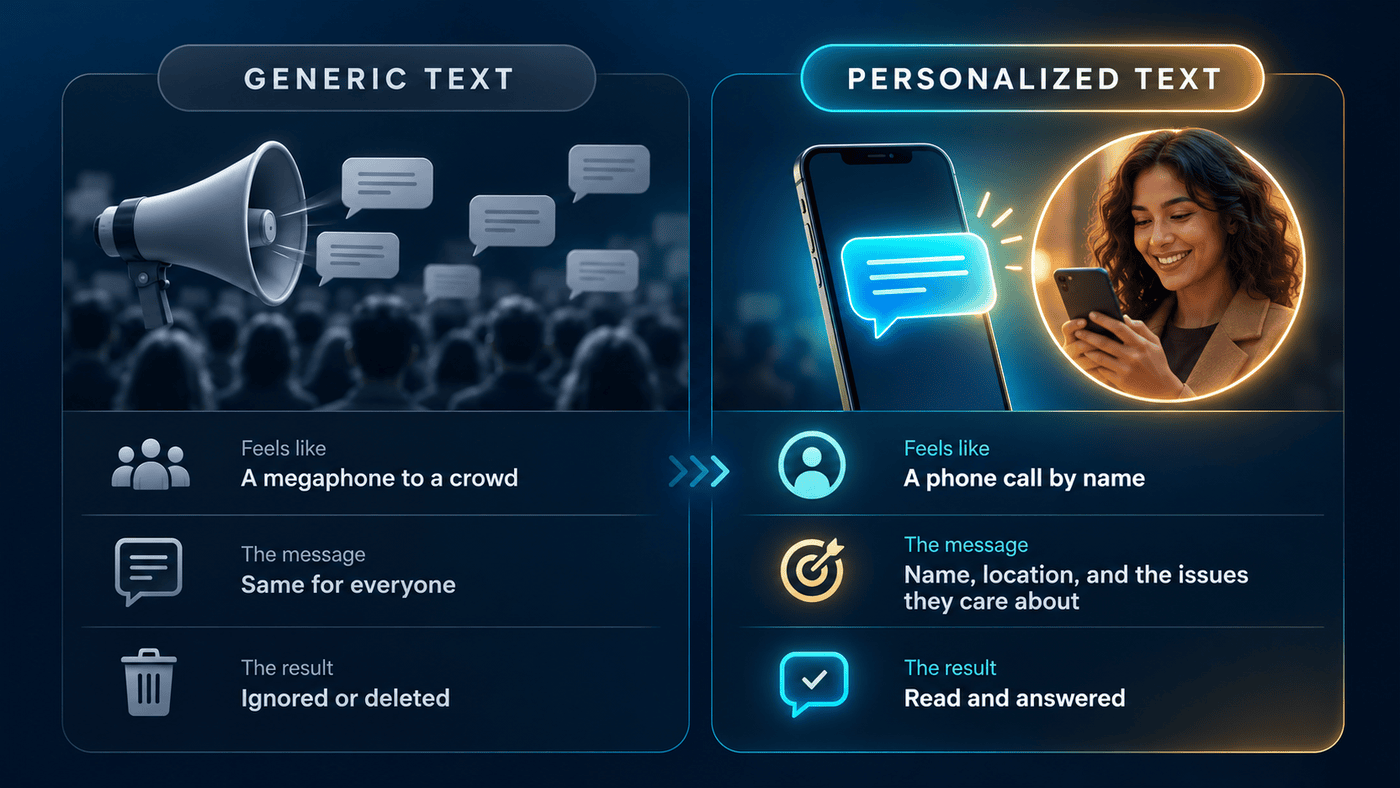
Generic texts miss because they carry no emotional connection. Send the same boilerplate to everyone and it reads as exactly that.
A generic message is a megaphone in a crowd. A personalized one is a phone call by name. The megaphone leaves voters feeling like one face in a sea of thousands. The call makes them feel seen.
Take the politics out of it for a second. You get one text that says "Hey, what's up?" and another that says "Hi, Mark. How did your presentation go at work today?" You answer the second one. Your voters do too.
How to Personalize Your Political Texts
Personalized texting is not hard. It comes down to a few repeatable habits: using voter data, incorporating dynamic content, and inviting two-way communication.
Use voter data
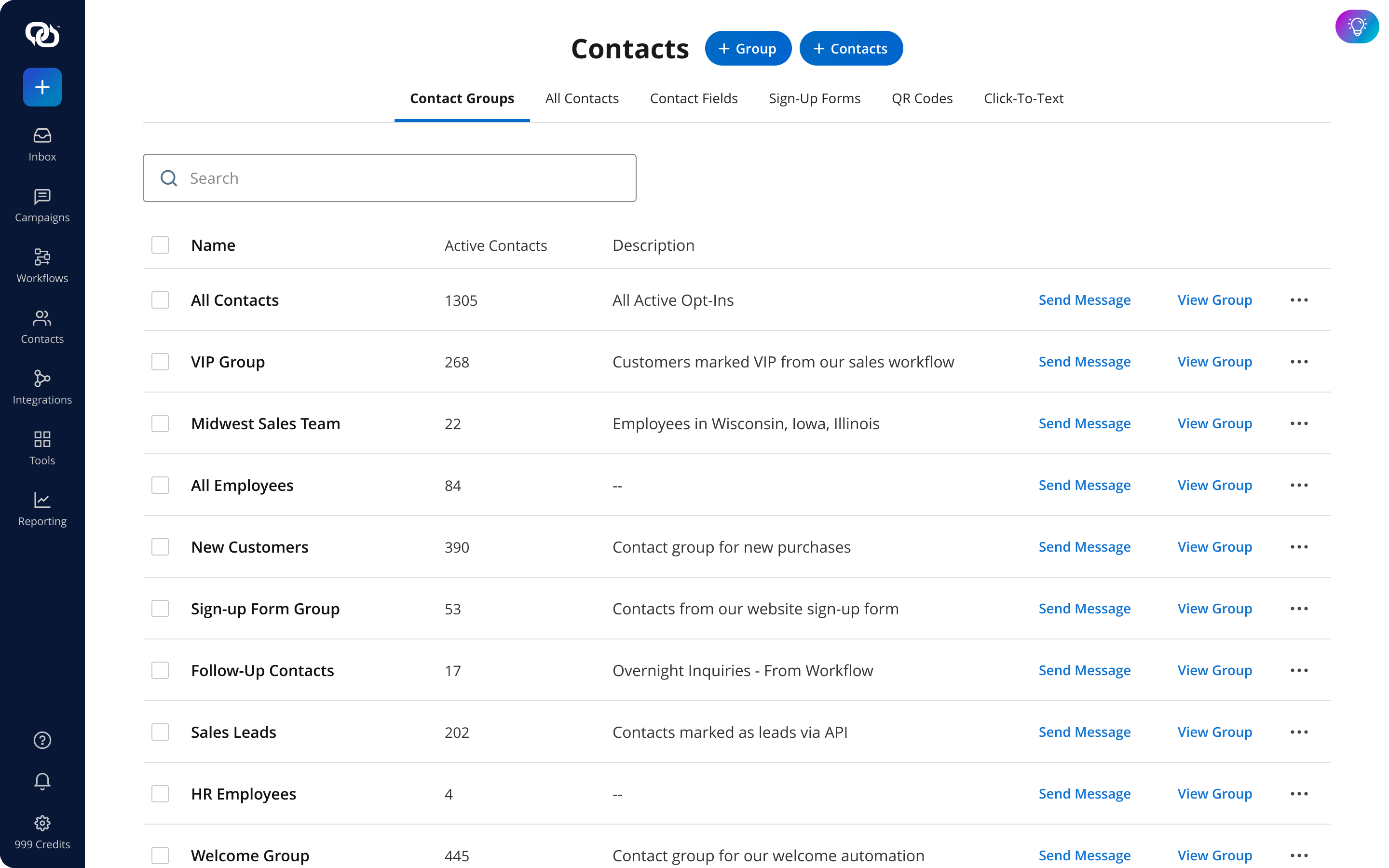
The data you already collect is the raw material for personalization. Demographics and preferences tell you a voter's age, location, income, and interests.
Behavioral data goes further. A record showing someone volunteered at last year's canvassing event, or donated to your past few campaigns, tells you they are already involved and open to doing more. Use it to send tailored asks: a nudge to volunteer again, or to give a little more.
Understand micro-targeting
Voter data also lets you micro-target: group voters who share characteristics and send each group a message built for them. Smaller, more specific groups get more relevant texts, and relevant texts get responses.
Say you are hosting a rally in San Diego. If you know your voters' zip codes, you can text everyone in the surrounding area, and stretch it to Orange County and Los Angeles voters within an easy drive. That beats blasting every California voter, since someone hundreds of miles away gets a message that means nothing to them. Too many irrelevant texts and voters tune out or opt out.
Incorporate dynamic content
Dynamic content pulls live data into each message: a voter's name, their location, or a recommendation based on their history. It also carries time-sensitive updates well, like a changed polling location, a reminder that polls close soon, or a real-time campaign update.
Encourage two-way communication
Some tactics pay off later. Invite voters into a conversation now, with a poll or a short survey, and their replies become the data that personalizes your next message. If a voter tells you they want to hear more about your candidate's tax plan, you can put that voter on a list for tax-related updates.
Examples of Powerful Personalized Texts
You know what personalization means by now. Here is what it looks like in a real text thread, grouped by the kind of message you send most: calls to action, invitations, and updates.
Personalized calls to action
Every text you send should ask for one clear action, like clicking a link or signing a petition. Personalize the ask and more people take it. For a group of voters who recently attended a climate rally, your text might read:
You can also use a call to action to gather feedback after an event:
Personalized invitations
Invitations to rallies, debates, volunteer shifts, registration drives, and get-out-the-vote events build excitement and turn supporters into participants. Add RSVP options and reminders to keep them engaged:
Or point an invitation at a voter's own neighborhood:
Personalized updates
Updates keep voters informed about the campaign, their registration, and Election Day. A polling reminder is a simple, high-impact way to turn a supporter into a voter:
A well-timed follow-up later in the day can catch the voters who meant to go and lost track of time:
In every one of these, a first name and a detail that belongs to the voter does the heavy lifting.
Measuring the ROI of Personalized Texting
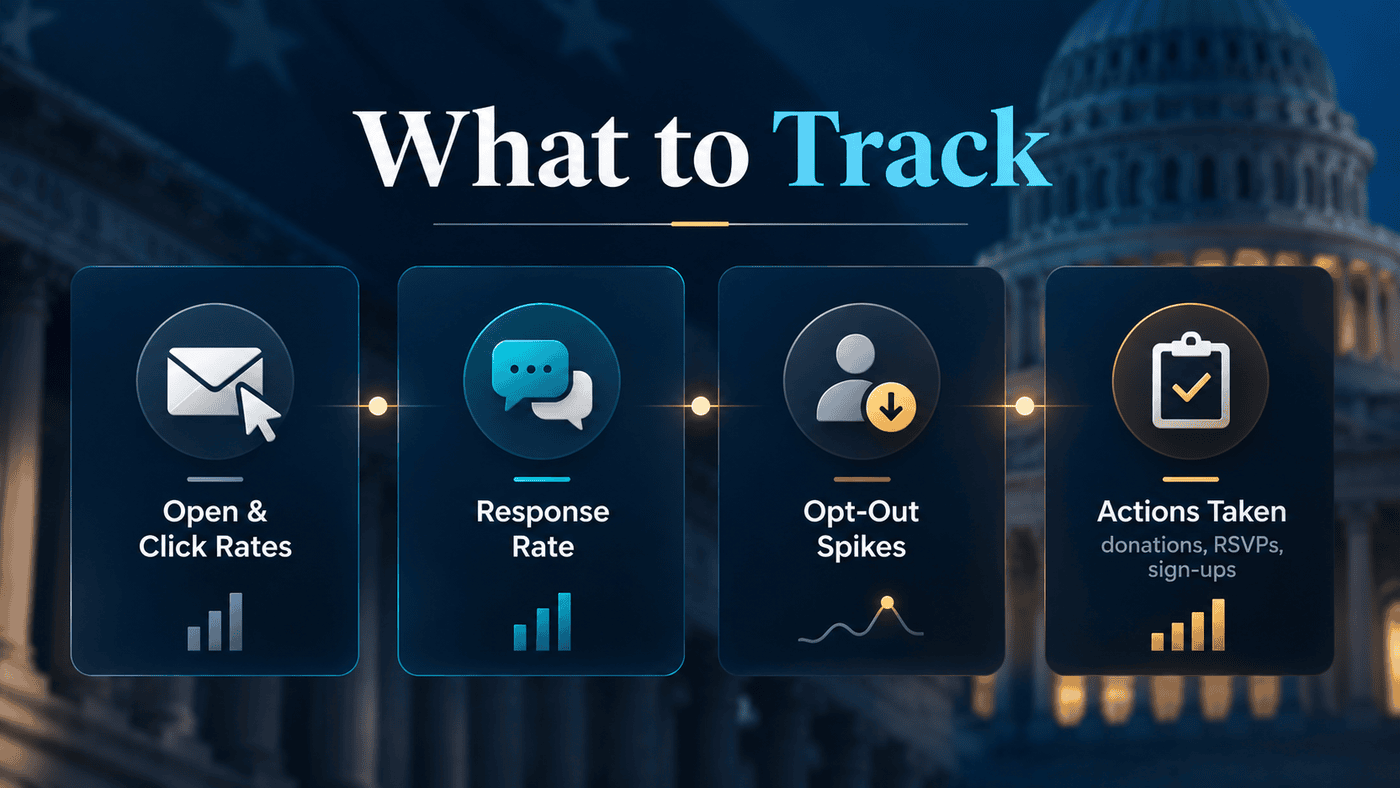
To know whether your personalized texts are working, track their performance. The ultimate score is votes, but you cannot wait until Election Day to find out if your messages landed. Watch these signals instead:
- Open and click-through rates: how many voters read your texts and tap your links.
- Response rates: how many reply, the clearest sign of real engagement.
- Opt-out spikes: a jump in STOP requests means your outreach is missing the mark.
- Actions taken: donations, event RSVPs, and volunteer sign-ups tied to your calls to action.
Look past the message metrics too. Voter turnout, donation totals, and volunteer numbers tell you what is working and what needs a tweak. Compare results against a control group for the real picture, then feed what you learn into your next campaign.
Ethical Considerations and Best Practices
As with any SMS program, knowing the best practices and the rules keeps you out of legal trouble and in your voters' good graces. Two principles carry most of the weight: be transparent, and follow the regulations.
Be transparent
Transparency means being honest about who the texts come from and how you collect and use voter data. Voters who trust where a message came from are far more likely to engage with it.
Comply with the regulations
Before you send a single text, get familiar with the CAN-SPAM Act and the Telephone Consumer Protection Act (TCPA), the laws that govern marketing communication. The core requirement is consent: give voters a clear way to opt in and to opt out. When a voter opts in, they agree to hear from you. When they opt out, you remove them from your list and stop texting them.
If your messages reach voters in the European Union, the GDPR applies too. That means protecting voter data and understanding the rules around what you collect, how you store it, and when a breach must be reported.
Personalized Texting in an Omnichannel Strategy
A campaign plan that pairs SMS with your other outreach reaches more voters and drives more engagement than texting alone.
Personalized texting fits an omnichannel strategy because it works alongside email, social media, TV and radio ads, and in-person campaigning. Run them together instead of leaning on one, and you widen your reach.
The channels cover for each other. A voter who rarely opens email will probably still see your text, and a voter who misses you on one channel tends to catch you on another. The overlap gives you more ways to land your message in front of the people who decide the race.
The Future of Personalized Political Texting
Staying current with the trends helps you and your voters get more out of every message. Two shifts are already changing personalized political texting: smarter AI insights and deeper use of voter data.
AI can track voter behavior through clicks, searches, and comments, then turn that into usable data. Predictive analytics go a step further, modeling a voter's needs and habits so your content speaks to them more directly.
Chatbots are part of that shift. They handle basic questions through conversational texting, gather preferences, watch for patterns, and route voters to the right resources, drawing on past data to keep the exchange personal.
Ready to connect with voters on a personal level?
If you are ready to personalize your outreach, EZ Texting gives you the tools to do it: the segmentation, dynamic fields, and two-way texting that make every message feel one-to-one. Sign up for a 14-day trial today and try it for free.
Frequently Asked Questions About Political Text Personalization
Personalization matters because it signals that you understand the voter, and that drives deeper engagement and higher response rates. A text that uses a voter's name and references the issues or events they care about gets read and answered far more often than a generic blast.
Micro-targeting is grouping voters who share characteristics, like a zip code or an issue they care about, and sending each group a message built for them. Smaller, more specific groups get more relevant texts, which lifts engagement and lowers opt-outs.
Track message metrics like open, click-through, and response rates, then tie them to real outcomes: donations, event RSVPs, volunteer sign-ups, and turnout. Compare your results against a control group, and use what you learn to refine the next round of messages.
Get express written consent before you text, following the TCPA and CAN-SPAM Act. Identify your campaign in every message, always offer a clear opt-out, and honor privacy rules like the GDPR when your messages reach voters it covers.
Yes. Chatbots can handle basic inquiries, gather voter preferences, and route people to the right resources through conversational texting, and they can draw on data you have already collected to keep each exchange personal.
See other related to Industries:
See other related to Features:
See other related to Use Cases:
See other related to Topics: