Agile Political Texting: Why SMS Is the Fastest, Safest Channel for Campaigns
See why a direct, opt-in text channel is a safer, more agile bet than social media for political outreach.
- Speed wins races. Texts are opened at a 98% rate and 87% of consumers read a new text within 15 minutes, according to the 2026 EZ Texting Consumer Texting Behavior Report, so your message reaches voters before news cycles move on.
- Other channels leak attention. Email opens at roughly 18%, and 8 in 10 Americans do not answer calls from unknown numbers, per Pew Research, which is why phone and email cannot match SMS for agility.
- Texting scales without friction. Keywords, QR codes, and web signup forms grow your voter list, and most are included free in a political texting plan.
- Compliance is not optional. Identify your campaign, honor TCPA hours, collect opt-in consent, and stop on opt-out, every single send.
- AI removes the bottleneck. Tools like AI Compose and Team Inbox cut drafting and reply time, and AI Compose drives a 30% increase in SMS response rates.
- EZ Texting's position: in a political cycle, SMS is the only channel fast enough and reliable enough to be a campaign's primary voter-communication tool, not a backup.
Why Agility Matters in Political Communication
Agility in a campaign is the ability to anticipate a shift, adjust your message, and reach voters before the moment passes, and no channel enables that faster than text.

In business, agility means anticipating change, adjusting, and thriving through it. A campaign is a business, and your constituents, with their needs, preferences, and concerns, are your customers. To win an election or move an issue, you have to communicate, persuade, and mobilize on a timeline you do not fully control. A debate moment, an opponent's misstep, a sudden polling-location change: each demands a response in hours, not days.
That is where the channel you choose decides whether you can keep up. SMS reaches voters immediately, drives action, and scales as your audience grows. According to the 2026 EZ Texting Consumer Texting Behavior Report, 80% or more of consumers respond to a text within 15 minutes, so a campaign can take the pulse of its base and adjust strategy in near real time. Political texting is not just another channel on the list. It is the one built for the speed politics actually runs at.
How SMS Compares to Your Other Campaign Channels
Text beats every other outreach channel on the two things a campaign cannot buy back: speed and certainty that the message was seen.
Your campaign will still use email, phones, mailers, and social media, and each has a role. But when you line them up against the demands of an agile campaign, SMS is the channel that consistently gets read and gets read fast.
| Channel | Gets read | Speed to reach voters | Trackable | Agility for a campaign |
|---|---|---|---|---|
| SMS | 98% open rate, 87% read within 15 min | Near-instant | Fully (links, replies, delivery) | Highest |
| About 18% open rate | Hours to days | Yes | Low | |
| Phone banking | 8 in 10 ignore unknown numbers | Slow, labor-intensive | Hard to measure | Low |
| Direct mail | No open signal | Days to produce and deliver | Very hard | Low |
| Social media | Algorithm decides reach | Variable | Partial | Moderate |
Sources: open, read, and response figures from the 2026 EZ Texting Consumer Texting Behavior Report; unknown-call avoidance from Pew Research.
Text vs. email. Email is buried. Text is read. SMS opens at about 98% against email's 18%, and the average text draws a reply in roughly 90 seconds versus about 90 minutes for email. When you need voters to see a rally time change today, that gap is the difference between a full room and an empty one.
Text vs. phone. Two-way conversations still matter, especially with older voters, but Pew Research found that 8 in 10 Americans do not answer calls from unknown numbers. A text lands, gets read, and invites a reply on the voter's own schedule, which is exactly the kind of two-way listening a phone bank promises but rarely delivers at scale.
Text vs. mailers. Direct mail reinforces well right before Election Day and stays cheap per piece, but it is slow to design, slow to deliver, and nearly impossible to track. Texting is fast, reliably delivered, and measurable down to the click, so you know what moved and what did not.
Text vs. social media. On social, an algorithm decides who sees your post. With text, there is no algorithm between you and your subscribers, just a direct line to voters who opted in. For a message you cannot afford to have filtered, that certainty is the whole point.
The Benefits of a Political Text Channel
A political text channel gives a campaign five compounding advantages: streamlined communication, faster mobilization, low-cost scale, real personalization, and lighter internal workload.

Streamlined communication
Voters want relevant, helpful information quickly, and a text platform delivers it without overwhelming them. Group texting, one-to-one replies, scheduling, and segmentation let you manage the entire voter journey from one place. Texting also forces clarity: dense policy becomes a bite-size update with a link to learn more, so voters get the point without the fatigue that makes them tune out.
Voter mobilization
Mobilization lives or dies on response speed, and texting is built for it. With 80% or more of consumers replying within 15 minutes (2026 EZ Texting Consumer Texting Behavior Report), a get-out-the-vote text turns into action fast: a click to your site, a "YES" to a rally, a forward to a friend, a completed voter registration. Urgent grassroots alerts are where SMS outperforms every other channel.
Outreach at scale
Whether your race is statewide or hyperlocal, you need a framework to grow without ballooning costs. SMS list-growth tools like QR codes, text-to-join keywords, click-to-text buttons, and web signup forms put your message in front of more voters, and most are included free in a political texting plan. The demand is there: Grand View Research values the U.S. SMS marketing market at $2.86 billion in 2023 and projects $9.96 billion by 2030, a 20.8% CAGR, and CTIA reports Americans exchanged roughly 2.2 trillion SMS and MMS messages in 2024. Voters already live in their text inbox.
Meets voters where they are
Texting is personal. By using voter data to segment your list, you can send the right message at the right moment: location-specific polling info, issue updates a contact actually cares about, reminders timed to early voting in their county. That relevance makes a voter feel seen rather than counted, and it gives your campaign a live feedback loop to keep adjusting as opinions shift.
Lighter internal workflows
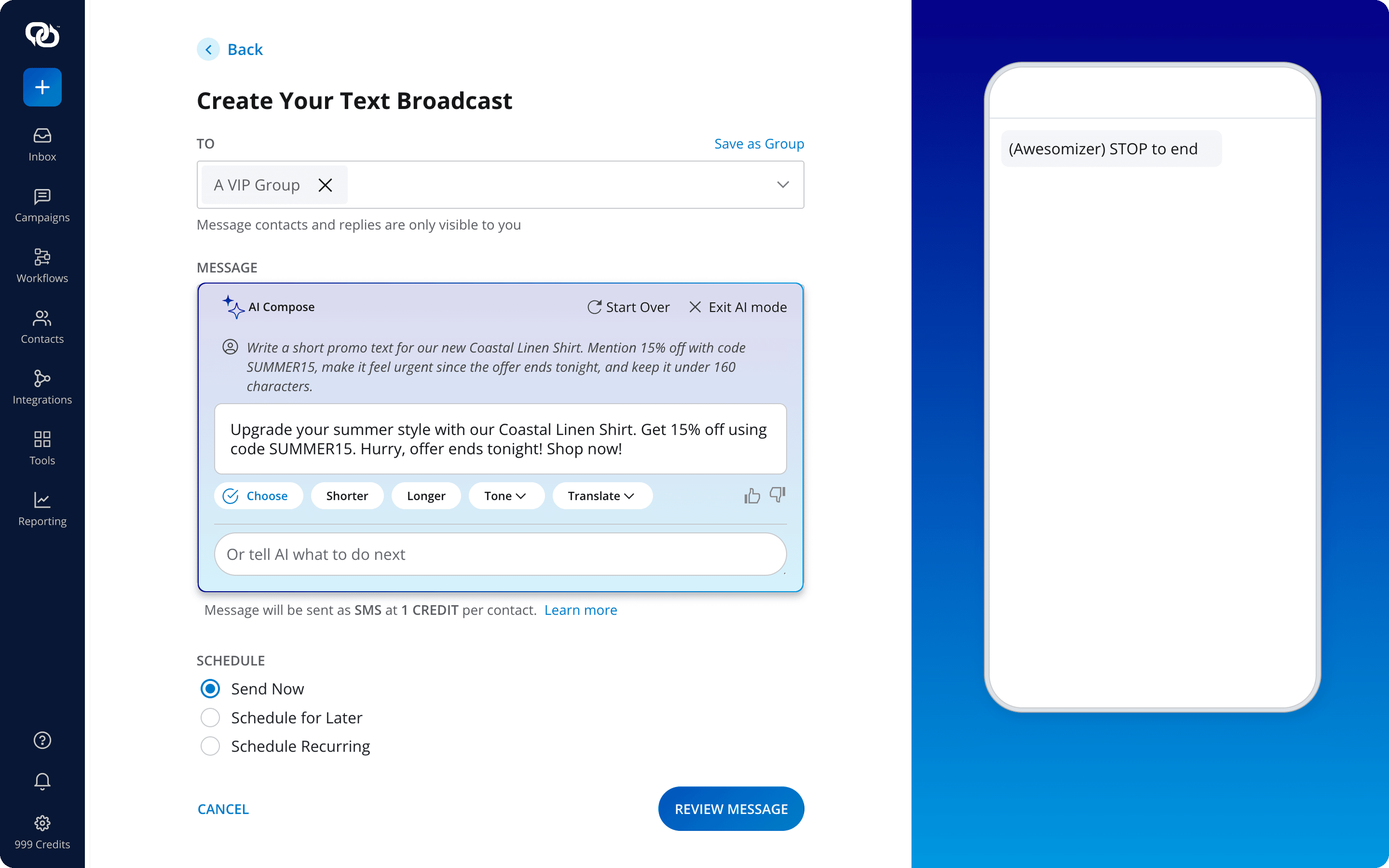
A text channel also takes weight off your team. Messages are short by design, an SMS runs to 160 characters, so drafting is fast, and platforms layer AI on top of that. EZ Texting's AI Compose and Team Inbox speed up both writing and replies, and AI Compose alone drives a 30% increase in SMS response rates. The payoff is a nimbler operation: launch a blast in a few clicks, respond at speed, and free your staff to run the rest of the campaign.
Best Practices for Political SMS Outreach
Effective political texting comes down to four disciplines: send at the right cadence, write in the right voice, use every tool the platform gives you, and treat compliance as non-negotiable.
Send at the right time and frequency
Aim for about one text per week so voters stay engaged without feeling bombarded, and flex that cadence around Election Day reminders or high-engagement moments. Schedule around the workday, the lunch hour and early evening tend to get the most reads. Set auto-reply messages to thank voters instantly when they donate or RSVP, on top of your prescheduled sends.
Sample GOTV text:
Hi [First Name], it's the [Candidate] campaign. Polls in [County] are open until 8 PM today. Find your polling place: [link]. Reply STOP to opt out.
Test your message
Small wording changes move response rates, so A/B test before a big send. Try two variants on a slice of your list and roll out the winner.
- Variant A (urgency): "Early voting ends Friday. Make your plan now: [link]"
- Variant B (identity): "You're a [City] voter who shows up. Early voting ends Friday: [link]"
Use the right language and tone
Keep every message persuasive but professional, and tailor it to the segment, whether that means local references, an issue that matters to that group, or generationally appropriate phrasing. Relevance is what keeps a voter opted in.
Prioritize compliance
In political texting, compliance is not a best practice, it is a requirement. Treat these as hard rules on every send:
- Identify your campaign clearly in the message.
- Send only during TCPA-approved hours.
- Collect express opt-in consent before you text anyone.
- Stop immediately when someone opts out.
Sample opt-in language for a signup form or keyword:
Text VOTE to 12345 to get election updates from the [Candidate] campaign. Msg & data rates may apply. Msg frequency varies. Reply HELP for help, STOP to cancel.
Frequently Asked Questions About Political Texting
Yes, when it follows the rules. Campaigns must identify themselves, text only within TCPA-approved hours, obtain express opt-in consent before messaging, and honor opt-out requests. A compliance-first platform builds opt-in and opt-out handling into the workflow so your campaign stays within the law on every send.
About once a week is a safe baseline that keeps voters engaged without annoying them. Increase frequency around key moments like early voting, a rally, or Election Day, and let engagement data guide you. Transactional replies, such as a thank-you after a donation, can go out in addition to your scheduled cadence.
Considerably. SMS opens at roughly 98% versus about 18% for email, and the average text earns a reply in around 90 seconds compared with roughly 90 minutes for email, according to the 2026 EZ Texting Consumer Texting Behavior Report. For time-sensitive updates like a polling-location change, that speed is decisive.
Through opt-in growth tools: text-to-join keywords, QR codes on signs and literature, click-to-text buttons, and web signup forms. Each captures consent while adding voters to your list, and most are included in a political texting plan at no extra cost. See how to grow your list for the full playbook.
Keep it short, identified, and action-oriented. Lead with your campaign name, state one clear ask (vote, RSVP, donate, register), include a link, and add opt-out language. Because an SMS runs to about 160 characters, clarity is forced, and tools like AI Compose help you draft on-brand messages fast.
Because most calls never get answered. Pew Research found that 8 in 10 Americans do not answer calls from unknown numbers, while texts are read at a 87% rate within 15 minutes. Texting reaches more voters, respects their time by letting them reply when it suits them, and is far easier to track than a phone bank.
Stay Agile with EZ Texting
Your political text channel is how you reach constituents fast, adjust in real time, and run a campaign that keeps pace with the race. EZ Texting, trusted by 230,000+ customers and built for exactly this kind of speed, is your one-stop shop for compliant, scalable voter outreach. Start today with a 14-day free trial.
See other related to Industries:
See other related to Features:
See other related to Use Cases:
See other related to Topics: