How to Text Voters: The Strategies That Actually Get Read

Get ready to send your political campaign soaring with these top texting strategies.

Campaign staffer texting voters in a busy campaign office
Key Takeaways
  • SMS beats traditional outreach on speed and attention. A 98% open rate and a 90-second average response time outpace email's 18% open rate and 90-minute average response (EZ Texting data).
  • Microtargeting is the foundation. Segment by demographics, voting history, top issues, past engagement, and geography, using only compliant, reputable voter data.
  • Personalization plus a single clear CTA drives response. Identifying your campaign isn't just courtesy; it's a legal requirement.
  • Timing has a sweet spot. Send Monday through Thursday in three windows: 8 to 9 a.m., 11 a.m. to 2 p.m., and 6 to 8 p.m. Cap broadcasts at about one per week.
  • P2P and A2P follow different rules. Automated sends require 10DLC registration; manual peer-to-peer outreach does not.
  • SMS performs best inside an omnichannel plan coordinated with email, social, phone banking, direct mail, and advertising.
  • Track five metrics: click-through, opt-outs, poll/survey responses, fundraising conversions, and RSVP/volunteer signups. A/B test before every send.

Why Texting Outperforms Traditional Voter Outreach

To text voters effectively, segment your list with compliant voter data, personalize every message around one clear call to action, identify your campaign in the first line, and cap frequency at roughly one text per week. Texting works because it moves at the speed of a voter's attention: the average text earns a reply in about 90 seconds, while the average email waits closer to 90 minutes (2026 EZ Texting Consumer Texting Behavior Report). A voter reads your message the moment it lands and can respond in the same thread, ask where their polling place is, or confirm they plan to vote, all without leaving their phone. No other outreach channel closes the gap between send and response that fast.

Texting wins on immediacy above all: it is the only channel where a voter reads your message in seconds and can answer you on the spot, inside the same conversation.

Texting is not simply a faster version of a robocall. Two-way SMS lets a voter ask a question, take a poll, or donate without the pressure of a live conversation, which is why response rates hold up where phone banking stalls. Polls, surveys, and text-to-donate turn a one-way broadcast into an interaction.

Reach is a matter of public record. Americans sent roughly 2.2 trillion SMS and MMS messages in the most recent year measured (CTIA 2025 Annual Survey), and 98% of US adults own a cellphone capable of receiving them (Pew Research Center, 2026). You don't have to teach voters to use this channel.

Immediacy is where campaigns win or lose a GOTV window. Average SMS response time is 90 seconds; for email it's 90 minutes (EZ Texting data). When a polling-location reminder has to land before 7 p.m. on Election Day, that gap decides the outcome.

ChannelOpen / Read RateTypical Response TimeAutomationBest Campaign Use
SMS98% open~90 secondsYesGOTV, fundraising asks, event reminders, persuasion
Email18% open~90 minutesYesLong-form updates, donor stewardship, endorsements
Phone bankingNot comparableLive, if answeredLimitedDeep persuasion conversations with high-value targets
Direct mailNot comparableDaysNoName ID and low-frequency reinforcement

SMS and email figures: EZ Texting data. Phone and mail have no comparable open-rate measure, which is part of the point.

Our position: SMS is not the panic channel you bolt on in the final 72 hours. Campaigns that build a compliant, opted-in text list in the off-season enter the closing stretch with a direct line to voters, while campaigns that wait are still buying attention they could already own.

Step 1: Microtarget With Compliant Voter Data

Segment before you send. Untargeted blasts drive opt-outs; targeted sends drive replies.

Microtargeting means gathering voter attributes, grouping people who share them, and tailoring the message to each group. The most useful segmentation inputs for political texting are demographics, voting history, top issues, prior engagement with your messaging, and geographic location.

Pull that data from voter files and other compliant sources, then use analysts or modeling to estimate how a person is likely to vote and which issues move them. One campaign message then becomes five or six variants, each speaking to a group's real concern rather than a generic platform summary.

Ethics are not a footnote. Use only reputable political databases that comply with data privacy law, keep every claim factual, and don't build persuasion around manipulation. A campaign caught deceiving voters by text loses more than a list.

SMS and email figures: EZ Texting data. Phone and mail have no comparable open-rate measure, which is part of the point.

Step 2: Write Texts Voters Actually Respond To

Personalize the opening, make one ask, and identify yourself before anything else.
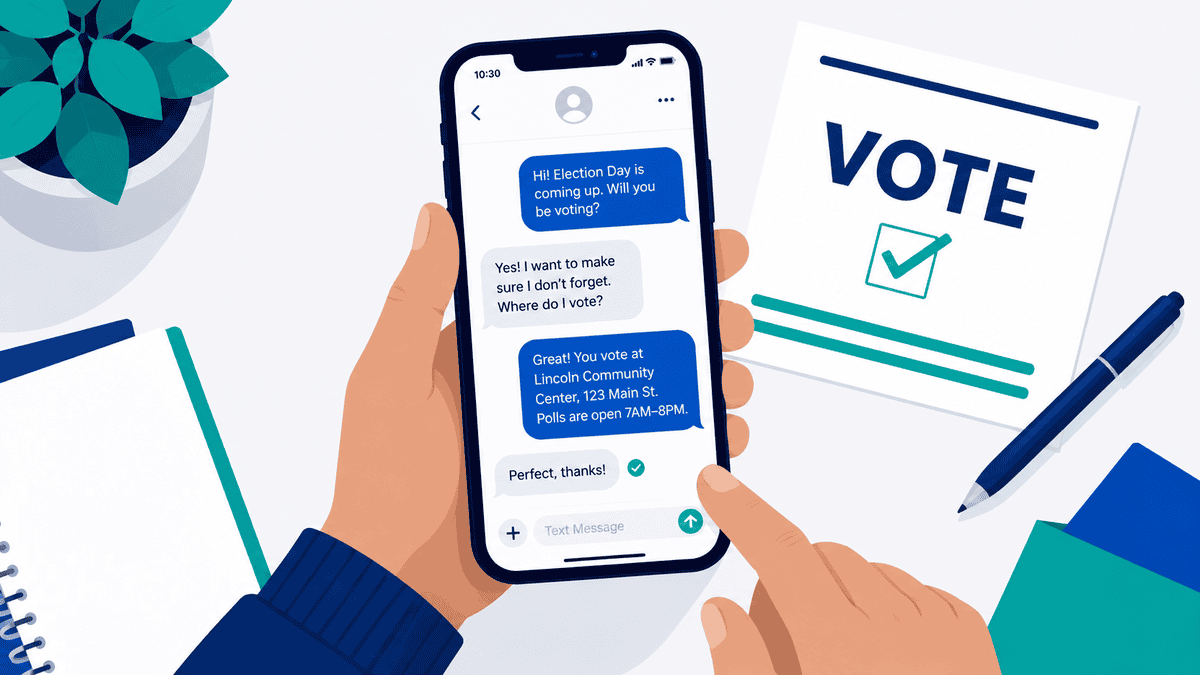
A voter having a two-way text conversation about when and where to vote.

A voter having a two-way text conversation about when and where to vote.

Personalization is the difference between a message and a mailing. The tactics that work: use the voter's first name, reference their city or district, build the message around an issue that matters to them personally or generationally, and time the send based on how they've engaged so far.

Then give them exactly one thing to do. Effective calls to action are specific, short, and carry a reason to act now: register for an event, donate, volunteer, RSVP, or reply to a question. Two competing asks in one text usually produce zero.

Fundraising example with a clear CTA:

What your customer receives
[Campaign Name] Hi {first_name}, will you support our campaign? Help us hit our fundraising goal and enter to win a free t-shirt. Donate today: {link}

Identifying yourself sounds minor and isn't. A text from an unfamiliar 10DLC number that opens straight into content reads as spam and gets deleted, and omitting sender identification also puts you outside compliance requirements. Lead with the campaign, candidate, or organization name every single time.

Interaction tools extend the same principle. Share a poll or survey so voters feel heard, use conversational two-way texting for real dialogue, and consider RCS messaging where you need branded sender identity, images, and tappable buttons. Voters are increasingly receptive to this: 54% report being comfortable interacting with automated text assistants (2026 EZ Texting Consumer Texting Behavior Report).

Step 3: Match the Message to the Voter

Age, region, and stage in the voting journey change the message more than party ID does.
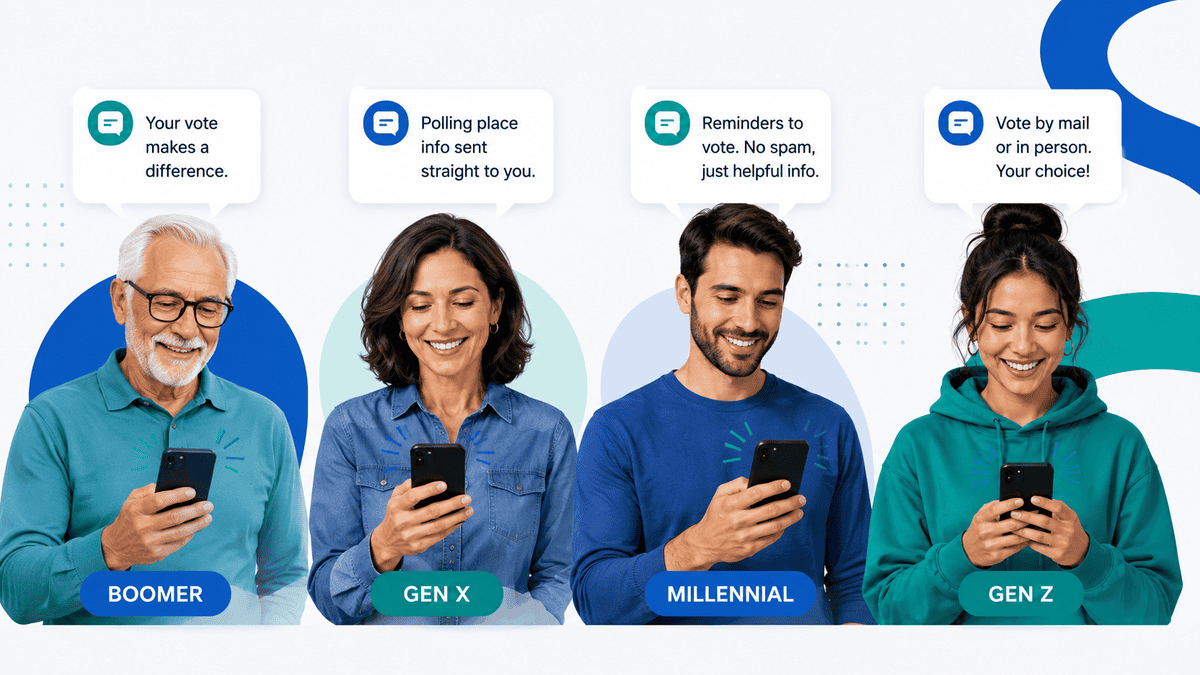
Voters of every generation, Boomer, Gen X, Millennial, and Gen Z, reading campaign texts on their phones.

Voters of every generation, Boomer, Gen X, Millennial, and Gen Z, reading campaign texts on their phones.

Age. Words, phrasing, and tone that land with one generation fall flat with another, and priority issues differ sharply. Healthcare and Social Security carry different weight for Baby Boomers than for first-time voters. Write per cohort, not per list.

Region and community. Tie your message to local issues, local legislation, and state-specific rules. A voter in a district facing a school bond vote hears a statewide talking point as noise.

Voting journey. Your contacts are at different stages: unregistered, registered but low-propensity, committed, or already voted early. Sending a registration deadline reminder to someone who voted two weeks ago is the fastest way to earn an opt-out. The most common texting mistakes are exactly these two: wrong tone for the audience, and content mismatched to local issues or voting stage.

Step 4: Educate Before You Ask

For swing and low-propensity voters, information converts better than pressure.

Education is the highest-impact strategy for voters who haven't decided or haven't historically turned out. Use MMS picture messaging to send short videos or images that make the civic case emotionally, then follow with substance: plain-language guides on candidates, ballot measures, and legislation.

Logistics are the last mile. Low-propensity voters often want to participate and don't know their polling place, its hours, whether early voting is open, or what ID their state requires. Text them that. Our guide to get out the vote (GOTV) efforts covers how to sequence those sends across the final weeks.

Step 5: Send at the Right Time and Frequency

Monday to Thursday, three windows, roughly one broadcast per week.

Voters keep unique work and family schedules, so treat these as starting points and tune against your own opt-out and response data.

VariableBest practiceWhy it works
DayMonday to ThursdayWeekday attention is higher; weekend messages compete with everything else
Time8 to 9 a.m., 11 a.m. to 2 p.m., 6 to 8 p.m.Catches voters before work, on a lunch break, and after hours
FrequencyNo more than one text per week or every other weekProtects the list from fatigue-driven opt-outs

Triggered messages are the exception. Donation thank-yous, registration confirmations, and event follow-ups fire off SMS automation in response to a voter's own action, so they don't count against your broadcast cadence. A voter who just donated expects the receipt.

Step 6: Choose Between P2P and A2P, and Register Correctly

P2P builds relationships one voter at a time; A2P scales. They carry different compliance obligations.

Peer-to-peer texting means a human sends each message individually rather than broadcasting to a group. It's more personal, more conversational, and reliably lifts response rates, which is why volunteer networks texting their own friends and family remain one of the strongest tools in field organizing.

Peer-to-Peer (P2P)Application-to-Person (A2P)
How messages sendIndividually, by a personPlatform broadcast or automated sequence
Volume ceilingLimited by volunteer hoursScales to full list
10DLC registrationNot required for manual sendsRequired
Strongest usePersuasion, volunteer recruitment, relational turnoutGOTV reminders, fundraising, event logistics
Trade-offLabor-intensiveLess conversational per message

Compliance runs underneath both. You may only text voters who have given prior express consent, automated senders must register for 10DLC, and opt-out must be honored immediately and easily. The distinction matters enough that we've written it up separately in A2P vs. P2P for political campaigns. Review our compliance guide and confirm your approach with your campaign's legal counsel before your first send.

Step 7: Make SMS the Spine of an Omnichannel Campaign

Texting is the fastest channel, not the only one. Coordinate it with everything else.
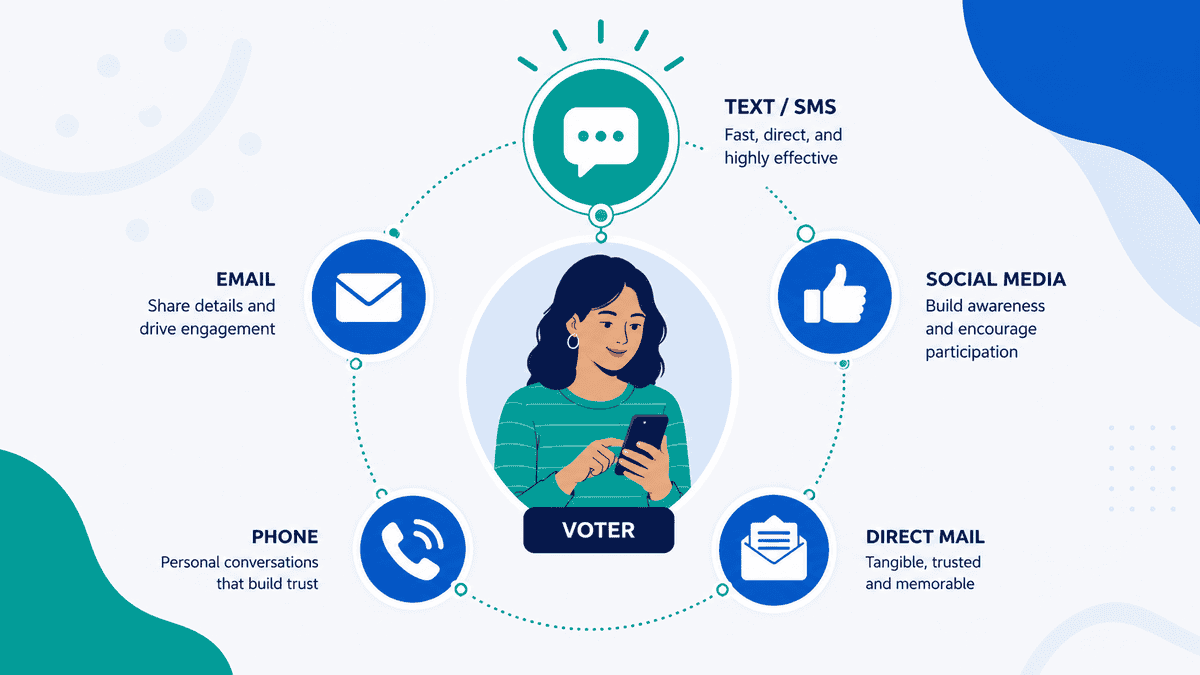
Omnichannel voter outreach, text, email, social media, phone, and direct mail around a voter, with SMS at the center.

Omnichannel voter outreach, text, email, social media, phone, and direct mail around a voter, with SMS at the center.

Voters differ in age, background, and preferred channel, so a single-channel campaign systematically misses people. Integrate text with email, social, phone banking, direct mail, and advertising, keeping graphics, language, and schedule aligned so the campaign reads as one voice.

Then connect the channels. Embed registration links in social posts and email blasts, put QR codes on yard signs and literature that drop voters into your text list, and use SMS to follow up on every offline touch. The channel read in 90 seconds is the one that should close the loop.

Step 8: Measure, Then Test Again

Five metrics tell you whether your voter texting program is working.
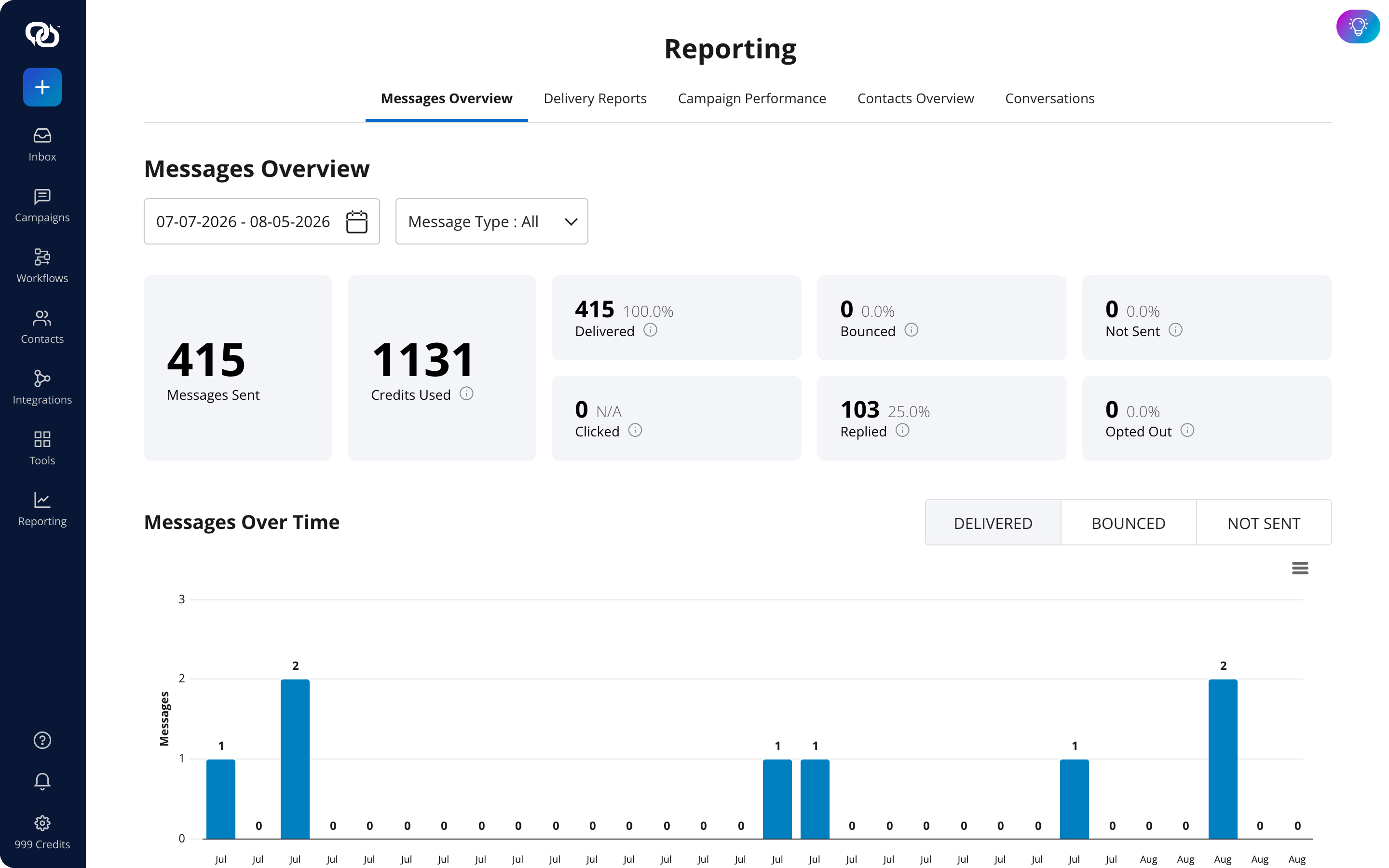
EZ Texting reporting dashboard showing campaign performance metrics.

EZ Texting’s reporting dashboard tracks the campaign metrics that matter, delivery, clicks, poll responses, and opt-outs.
  • Click-through rate. Shows whether your CTA and your framing are persuasive. Typical SMS click-through runs in the 21% to 35% range (EZ Texting and industry benchmarks).
  • Opt-out rate. Your fastest signal that message content, cadence, or send time is wrong.
  • Poll and survey responses. Low participation usually means the question needs rewording or the CTA needs strengthening.
  • Fundraising conversions. Tie text-to-donate and text-to-give revenue back to specific sends. Our guide to political fundraising covers the tactics that convert.
  • Event RSVPs and volunteer signups. The clearest proof that a message actually mobilized someone.

A/B test before every send, not just when something breaks. Run two versions that differ in exactly one element, CTA phrasing, message length, or personalization depth, and let the data pick:

What your customer receives
[Campaign Name] {first_name}, every dollar counts. Donating just helps us reach more voters like you and make meaningful change in our state. Donate today: {link}
[Campaign Name] {first_name}, every dollar counts. Donating just helps us reach more voters like you. Donate now to make an impact: {link}

Get Your First Text to Voters This Week

EZ Texting

From your first send to election night, EZ Texting handles the segmentation, automation, compliance tools, and reporting that voter outreach at scale demands, the same platform trusted by 230,000+ organizations that have sent more than 8 billion messages.

Build your list and send your first voter text today. Start your free trial, no credit card required.

Frequently Asked Questions About Texting Voters

You need a text marketing platform built for A2P messaging. Look specifically for bulk and segmented sending, two-way conversational texting, contact management, automation for triggered messages, analytics that report click-through and opt-out rates, and built-in compliance features including 10DLC registration support. See how EZ Texting supports political campaign goals.

Start with prior express consent, you may only text voters who opted in. Register for A2P 10DLC if you're sending automated messages, identify your campaign or candidate in every text, honor opt-out requests immediately, and source voter data only from reputable databases that follow data privacy law. Use a platform with compliance tooling built in, and review specifics with your campaign's legal counsel, since rules differ between P2P and A2P outreach.

Cap broadcast messages at roughly one per week, or one every other week for less engaged segments. Triggered messages, donation thank-yous, registration confirmations, and event reminders that a voter's own action initiated, sit outside that cadence. Watch your opt-out rate as the real limit: a rising opt-out rate means you've exceeded what your list will tolerate.

Three windows work best: 8 to 9 a.m., 11 a.m. to 2 p.m., and 6 to 8 p.m. local time, Monday through Thursday. These catch voters before work, during a lunch break, and in the evening. Avoid weekends, and validate against your own response and opt-out data rather than treating these as fixed rules.

The five most productive segmentation inputs are demographics, voting history, top issues, past engagement with your messaging, and geographic location. Combine two or three of them, for example, first-time voters in a specific county who engaged with a housing-policy message, and write to that intersection. Precision here is what separates a 30% click-through rate from a wave of opt-outs.

Neither is better; they solve different problems. P2P is more personal and more effective for persuasion, volunteer recruitment, and relational turnout, but it's limited by how many volunteer hours you have. A2P scales to your full list and handles GOTV reminders, fundraising, and logistics, but requires 10DLC registration and reads less like a conversation. Most competitive campaigns run both.

14-DAY FREE TRIAL
Take EZ Texting for a Spin
The easiest way to add SMS to your business. No credit card required.
1,000+ five-star reviews

Join the 230,000+ Who Have Used EZ Texting to Connect with Their Audiences.