How to Increase Your SMS Response Rate: Strategies That Actually Get Replies
Not getting the replies you expect from your text campaigns? This guide outlines what causes low SMS response rates, the tactics proven to lift them, and how EZ Texting's tools help you turn more contacts into conversations.


- A low SMS response rate often points to a fixable issue with your audience, timing, call to action, or message delivery.
- Segmenting contacts and tailoring messages to their interests or behavior can give people a more relevant reason to respond.
- SMS already out-responds nearly every other marketing channel, so it’s most helpful to test why a specific campaign is underperforming and then apply the fixes to future blasts.
What Counts as a Good SMS Response Rate
Have you ever launched an SMS campaign only to hear crickets? It’s not only frustrating to get low responses, but also not knowing why you didn’t get the expected response. There are a variety of potential reasons. Does it just come down to bad timing? Is there something about your message that isn’t landing right?
Learning how to increase SMS response rates starts with understanding where the breakdown is happening with your customers. This article looks at what a good response rate actually looks like, why campaigns underperform, and the changes you can make to get more customers responding.
Your SMS response rate measures how many people take the action you asked for after receiving a message. If you’re measuring replies specifically, the formula is simple:
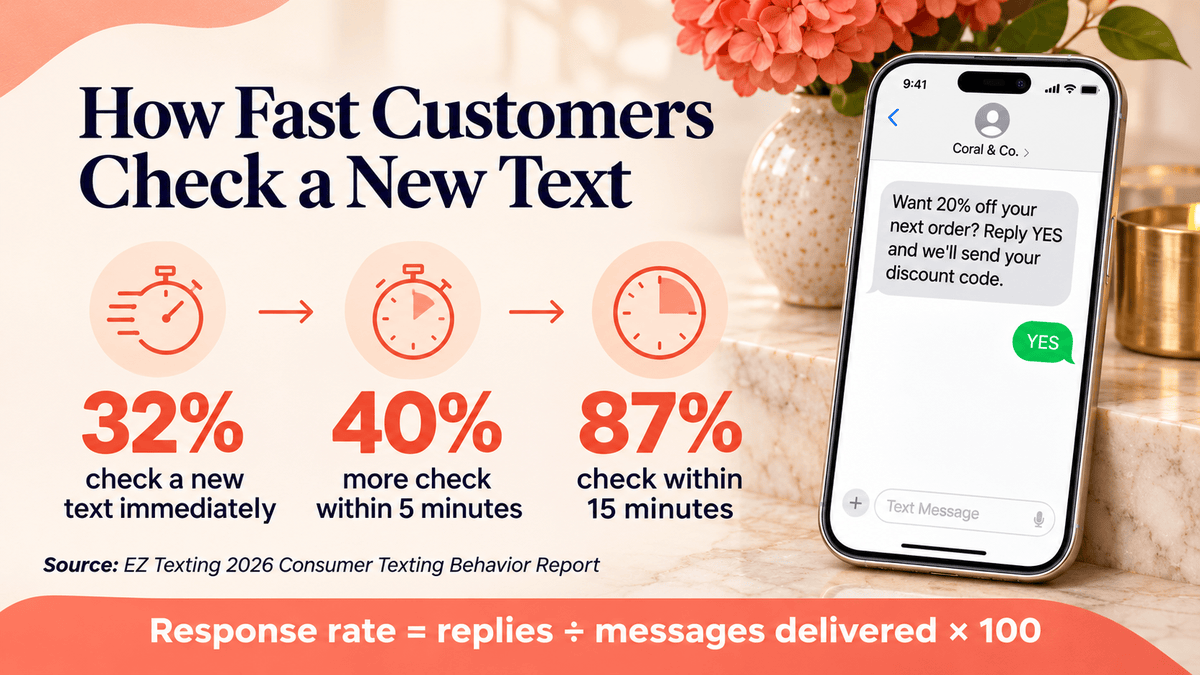
SMS response rate = (number of replies ÷ messages delivered) × 100
Response rate is different from open rate. An open rate tells you someone saw the message, while a response rate shows that they acted on it. If messages are reaching people (meaning they are at least being seen) but replies are low, your CTA, offer, audience, or timing may need work.
There also isn’t one response rate that every campaign should hit. A confirmation text that asks for a simple “YES” has a different job than a promotional message asking someone to make a purchase. Your expectations for response rates will be different for these separate goals.
What we do know is that SMS gets attention quickly. EZ Texting’s 2026 Consumer Texting Behavior Report found that 32% of consumers check a new text immediately, another 40% check within five minutes, and 87% within 15 minutes. Especially with SMS, the odds of your business getting a quick response are already in your favor.
To improve those rates, it’s just a matter of optimizing your SMS marketing texts around the action you actually want customers to take.
Personalization means more than adding a first name to your texts.
Core Strategies to Increase Your SMS Response Rate
Once you know why your response rate is low, these strategies focus on the parts of an SMS campaign you can adjust quickly and measure with your next outreach.
Segment and Personalize Every Send
Personalization means more than adding a first name to your texts. Details such as purchase history, location, signup source, or past engagement can help you send a message that reflects what the recipient actually cares about.
Use the information you already have to decide which contacts should receive a campaign and what would make them respond. A new lead who downloaded an offer might get a follow-up tied to that interest, while a repeat customer could receive a promotion based on something they’ve purchased before. For lapsed contacts, the message can acknowledge that it’s been a while and give them a specific reason to return.
Improving customer SMS engagement is really about reaching individuals, and segmentation can help you do that. Each segment gets a message based on its relationship with your business, not a generic promotion that goes to everyone, applicable or not.
Time Messages Around Real Behavior, Not Guesswork
The “best time” to send a text can vary widely depending on your audience and the type of text or campaign you are sending. Generally, you want to avoid super early mornings and late evenings, and a lot of consumers don’t want a slew of texts over the weekend.
A good place to learn is in your own backyard with your campaign history. Compare response rates across different send times and days to see when your own subscribers tend to engage. For lists that span multiple time zones, schedule messages based on each recipient’s local time rather than sending to everyone at once.
Frequency should also be analyzed. A fixed cadence isn’t always the answer, so consider testing how your audience responds as you increase or decrease sends. Many businesses start with one or two texts a week to test the waters. We found that 40% of consumers cite excessive frequency as a reason for opting out, so look at subscriber retention when you evaluate your schedule to see if you are over- or under-sending texts.
Write CTAs That Ask for One Clear Action
A customer shouldn’t have to reread your text three times to figure out what you want them to do. Stick to one action and put it where it’s easy to spot. Direct verbs such as “reply,” “book,” or “shop” make the next step perfectly clear. You also want to give them a reason to respond, often communicating a feeling of urgency, such as a deadline or a limited quantity.
Compare these two messages:
Before: “Our weekend sale is here! We have great deals throughout the store, so stop by or check out our latest offers online.”
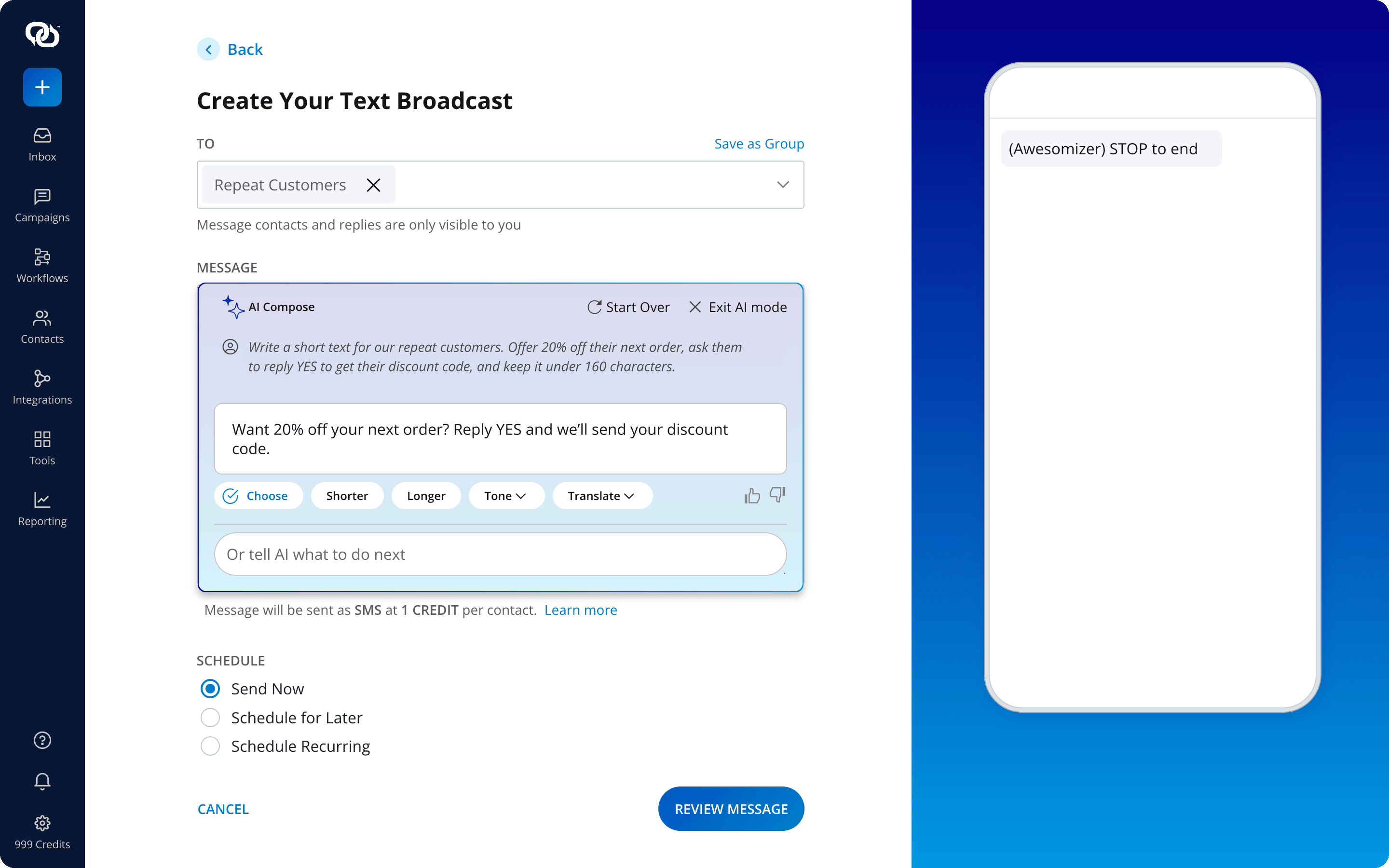
After: “Want 20% off your next order? Reply YES and we’ll send your discount code.”
The second version gives the recipient one decision to make and a simple way to respond. When it fits the campaign, a direct question can make that invitation even more natural because the message gives customers something specific to answer. If you need to provide more information, that’s what a landing page on your website is for.
Use Keywords, MMS, and AI-Powered Automation to Spark Two-Way Conversations
Keywords can simplify a desired response to a single, predefined action. Ask customers to text SAVE for a discount, for example, and anyone who responds has also signaled interest in that offer. You can use that interaction to shape what comes next, such as sending the discount or adding the contact to a relevant segment. Polls and A/B choices work on the same principle, where the response is quick for the customer and extracts useful information for your future messages.
Visuals can also make promotional messages more compelling. EZ Texting found that 64% of consumers are more likely to click or purchase when a promotional text includes an image. A product photo, coupon graphic, or short GIF can add useful context while keeping the desired action front and center.
AI can help you experiment with the copy itself. AI Compose can generate variations of a message with different tones or lengths, giving you options to test rather than rewriting each version manually. Pair those experiments with SMS marketing best practices to see which combinations generate more replies.
See other related to Features:
See other related to Use Cases:
See other related to Topics:
