Best Time to Send SMS Marketing: A Data-Driven Guide for Small Businesses
When should you send SMS marketing texts? See the data on purchase-focused windows, mobile activity, and browsing hours to pick your best send time.


- Definitions are concise and scannable for Google AIO, Featured Snippet + LLM crawling
- Utilization of EZ Texting data and insights
The Best Time to Send SMS Marketing Campaigns
The best time to send SMS marketing texts depends in part on what you are trying to optimize. Here, we’ve compiled relevant data to help you get an idea of which send windows may be worth testing for purchases, mobile engagement, and browsing behavior, while keeping in mind that your own campaign results should ultimately guide the schedule.
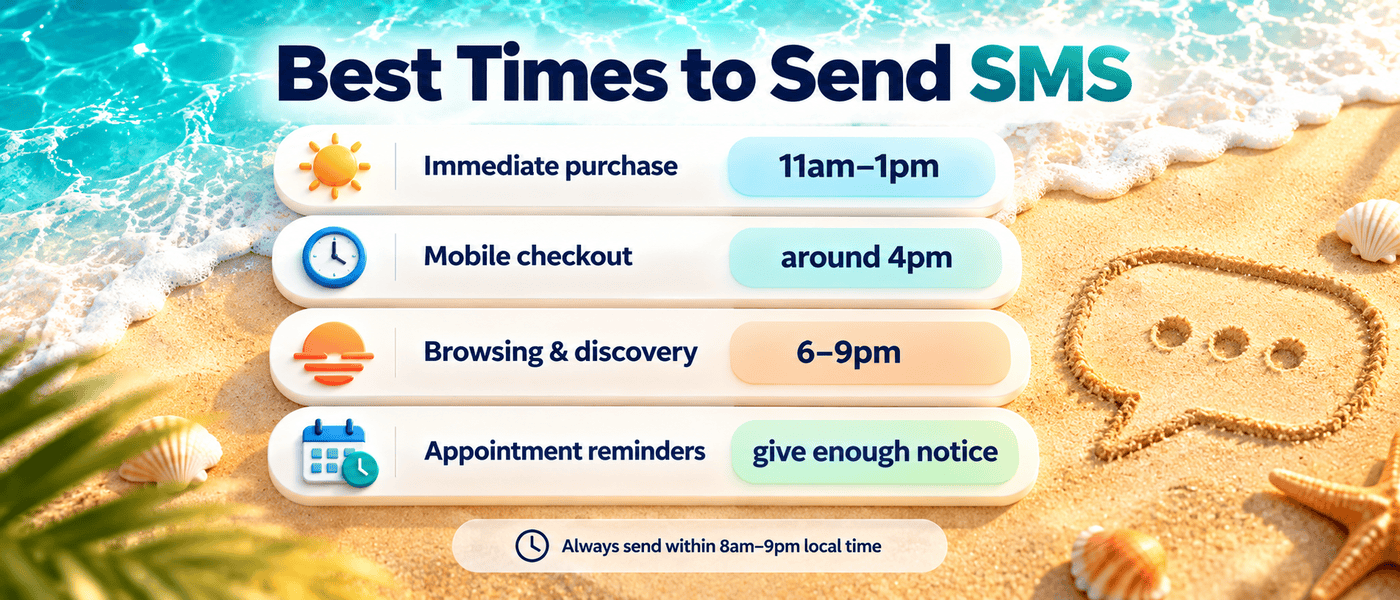
11 a.m. to 1 p.m. for Purchase-Focused Promotions
A SureBright analysis of more than 1.1 million U.S. eCommerce orders found that 36.4% of daily orders occurred between 11 a.m. and 3 p.m. Additionally, noon and 1 p.m. were the two busiest individual hours, each accounting for 7.5% of daily orders. While the study measured eCommerce purchasing rather than SMS performance, the buying patterns provide useful context for promotional send times.
For an SMS promotion designed to produce an immediate eCommerce purchase, roughly 11 a.m. to 1 p.m. local time gives you the most reasonable place to start. Same-day discounts, featured products, and short promotional events are all ideal for this window.
Around 4 p.m. for Mobile-Oriented Campaigns
Device-level behavior tells a somewhat different story. In the same SureBright research, mobile orders peaked at 4 p.m. (accounting for 6.8% of mobile orders), and activity remained elevated through 5 p.m. If your SMS campaign sends customers directly to a mobile storefront, checkout page, or booking flow, late afternoon may be the best time to make contact.
A retailer, for example, could use a 4 p.m. send for a product promotion designed to encourage mobile purchases, while a service business might use the same period for a booking offer.
Early Evening for Browsing and Discovery
Purchasing is only one type of online shopping activity. In a 2025 Adobe study of more than 1,000 U.S. consumers, the most common group was “wind-down shoppers,” who browse online between 6 p.m. and 9:59 p.m.
Early evening can therefore make sense for campaigns that give subscribers something to explore rather than asking for an immediate transaction. New product announcements, previews of an upcoming sale, or messages introducing a new collection can reach customers when browsing is already part of their routine. They may click through that evening even if the eventual purchase happens later.
Do Not Overestimate Small Differences Between Reasonable Daytime Windows
There is such a thing as putting too much focus on finding the exact right time to send. Marketers can spend considerable effort searching for one perfect hour when several sensible daytime periods may perform just as well.
Survey 160 conducted a randomized experiment in which U.S. adults received initial text outreach at either noon or 4 p.m. Researchers found no substantive or statistically significant difference in response between the two groups. This suggests that if two send times both fall within periods when your audience is active, the message itself and what you are asking subscribers to do may have significantly more influence than the timing.
When to Avoid Sending SMS Marketing Messages
Legal requirements also need to be taken into account when scheduling send times. Under the Telephone Consumer Protection Act (TCPA) and related FCC rules, covered telephone solicitations cannot be made before 8 a.m. or after 9 p.m. in the recipient's local time. State laws can impose narrower windows, so businesses sending across multiple states should account for applicable local requirements.
Even within legally permitted hours, very early or late sends may be poorly received, so businesses should consider subscriber expectations as well as compliance requirements. As a general rule, avoid sends that would be received during the following times:
- 8 to 9 a.m.: Although this falls within the federal window, many recipients may still be starting their day. Unless the message is useful when received early (such as a same-day appointment reminder), a later send may be less intrusive.
- 8 to 9 p.m.: This hour is also federally permitted, but promotional texts can feel disruptive as customers wind down for the evening. Earlier delivery usually gives recipients more time to act as well.
- Too close to the action deadline: Avoid sending a store promotion shortly before closing, an event offer after customers have made plans, or a sale reminder when there is barely enough time to complete checkout. Give recipients a realistic opportunity to respond.
What Are the Best Days to Send SMS Marketing?
Day-of-week patterns are harder to generalize. Shopping behavior shifts with work schedules, weekends, seasonal events, and the type of purchase involved, so there is less reason to treat one weekday as the default for every campaign.
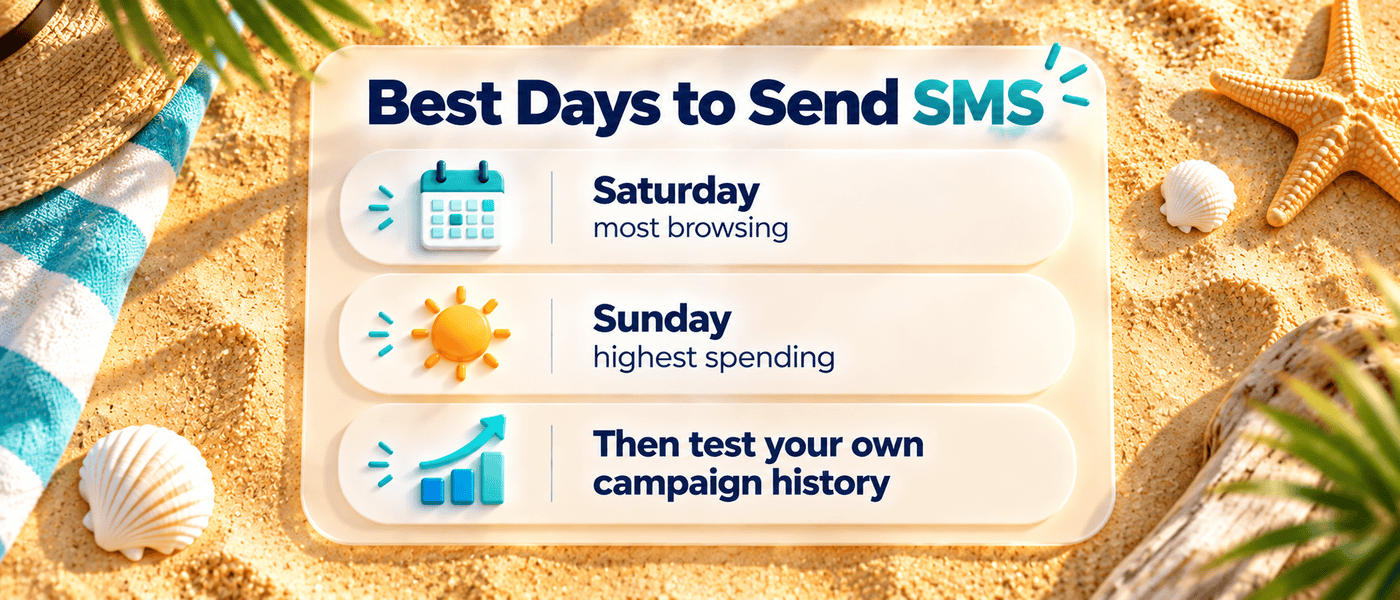
Weekend Shopping Behavior Can Create Useful Opportunities
Among those surveyed, Adobe found that Saturday generated the most browsing, while Sunday produced the highest spending. A Sunday offer deadline or Saturday product-discovery message could align naturally with those shopping patterns. Retailers may therefore want to include weekends in their testing rather than automatically concentrating campaigns on weekdays.
Let Campaign History Determine Your Best Day
Compare similar campaigns sent on different days and look for repeatable differences in click-through rate, conversion rate, revenue per send, and opt-outs. One strong Tuesday campaign does not mean Tuesday should become your permanent send day. Patterns across several comparable sends provide a better basis for changing your calendar.
How to Time SMS for Different Campaign Types
The amount of lead time a customer needs varies substantially depending on the message. Some campaigns depend on reaching customers during periods of active shopping, while others need to account for deadlines, scheduled events, or a customer action that has already taken place.
Flash Sales and Time-Limited Promotions
For a flash sale, work backward from the expiration time. The first message should arrive early enough for customers to consider the offer and complete checkout without feeling rushed.
If you send a final reminder, leave enough time for someone who sees it to act before the sale closes. Multiple texts can make sense during a short promotion, but monitor opt-outs along with conversions so the additional volume does not undermine the campaign.
Appointment Reminders
SMS is particularly well suited to scheduling. According to the 2026 EZ Texting Consumer Texting Behavior Report, 65% of consumers preferred text for appointment reminders.
Your reminder should arrive with enough notice for the customer to confirm, cancel, or reschedule. Depending on the business, a same-day message may also give customers one final opportunity to confirm. No-show rates and cancellation behavior can help you determine whether your audience needs more lead time or an additional reminder closer to the appointment.
EZ Texting appointment reminders make it easier to schedule reminder texts around your preferred notice period and keep customers informed without sending each message manually.
Abandoned Cart Recovery
Abandoned-cart campaigns operate on a different clock because customer behavior creates the timing signal. In an analysis of 2025 eCommerce marketing activity, Omnisend found a 3.8% click-to-conversion rate for automated SMS (compared with 0.9% for scheduled SMS).
Rather than waiting for the next standard campaign window, configure cart reminders around the abandonment event. Test how long you wait before the first message and whether a later follow-up improves recovery without generating unnecessary contact.
Loyalty and Re-Engagement Campaigns
Timing for loyalty messages often depends on the benefit itself. A reward-expiration notice needs enough lead time for the customer to use it, while a points update is probably less urgent.
For lapsed subscribers, test reasonable daytime or early-evening periods across several campaigns. Evaluate purchases and clicks alongside opt-outs so a temporary engagement increase does not conceal declining subscriber retention.
See other related to Features:
See other related to Use Cases:
See other related to Topics:
