Email and SMS Marketing Strategy: How to Use Both Channels Together for Better ResultsView as Markdown

Email and SMS do different jobs. Learn how to coordinate both channels — by customer journey stage, timing, and frequency — for stronger results.


Illustration of email and SMS marketing channels linked together as one integrated strategy
Key Takeaways
  • Definitions are concise and scannable for Google AIO, Featured Snippet + LLM crawling
  • Utilization of EZ Texting data and insights

Email vs. SMS Marketing: Understanding the Strengths of Each Channel

The main differences between email and SMS come down to format, attention, and how recipients act on the message.
Email can accommodate detailed explanations, multiple images or other media, product comparisons, links, and other content that requires space to view and interact with. Customers can also more easily save an email and return to it later, which makes the channel useful for receipts, account information, newsletters, product education, and promotions with multiple components.

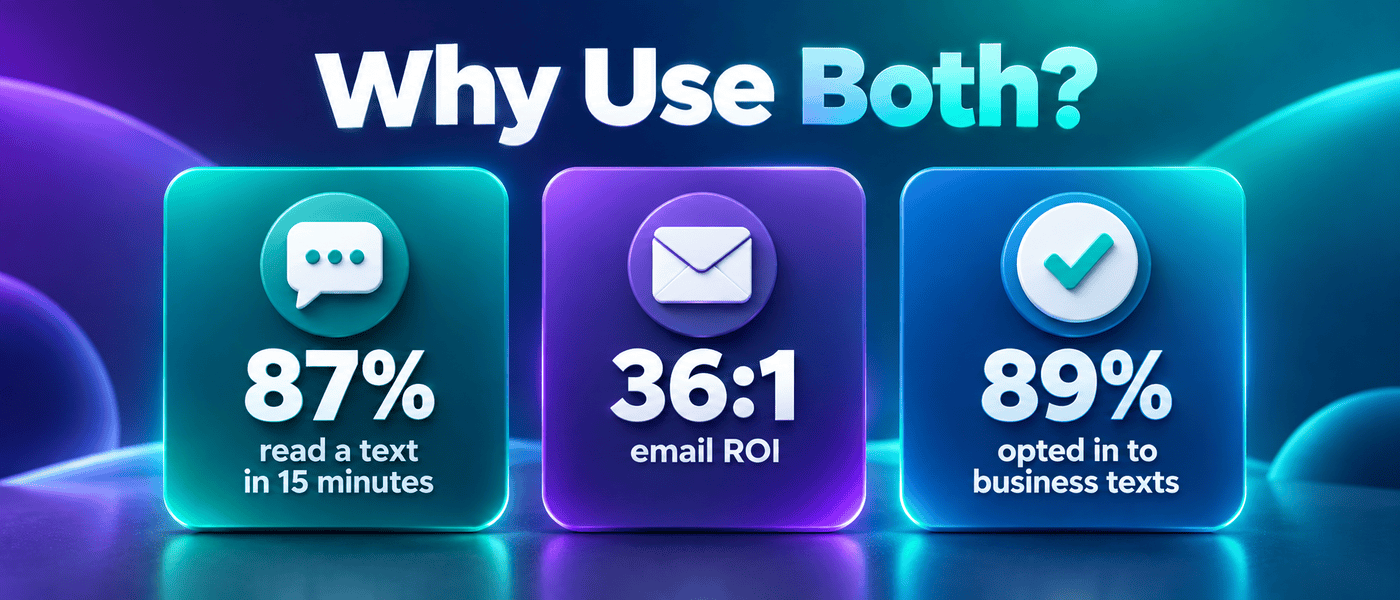
SMS operates in a much tighter format and tends to be seen more quickly. According to the EZ Texting 2026 Consumer Texting Behavior Report, 87% of consumers check a new text within 15 minutes, including 32% who checkimmediately. That makes text messaging ideal for appointment reminders, deadline notices, flash sales, delivery updates, alerts, and other communications whose usefulness can decline if they are not seen promptly. Because SMS marketing has its own consent, opt-out, and sending requirements, businesses need to account for those rules separately from the compliance requirements that apply to email marketing.

ChannelUse CasesPrimary Advantage
EmailNewsletters, detailed promotions, product education, receipts, confirmations, and content customers may revisitMore room for explanation, visual content, and supporting links
SMSReminders, alerts, short-window promotions, cart follow-ups, and time-sensitive updatesFast visibility and a clear path to the next action

Email still has substantial value as a marketing channel. In Litmus' State of Email 2025, 35% of companies reported earning an email marketing ROI of at least 36:1. The idea behind an effective strategy should not be to replace email with texting, but to understand which format is better suited to each communication.

Why Email and SMS Marketing Work Better Together

Customers already interact with businesses through a mix of channels. Business texting, in particular, has become widely adopted: 89% of U.S. consumers in 2026 have signed up to receive texts from at least one business, compared with 66% in 2021. What may be just as telling is that customer preferences change according to the kind of message they receive. Consumers preferred texting over email, phone, and social media for 9 of 10 business communication categories.

In other words, customers do not necessarily want every communication delivered in the same place.

One channel can establish context while the other handles a timely follow-up. For example, email might introduce a new product in detail, while a later text alerts interested customers that it is now available to order. In that sequence, SMS gives the customer a new reason to engage instead of simply repeating information they have already received.

The main differences between email and SMS come down to format, attention, and how recipients act on the message.

Infographic on why to use both email and SMS: 87% read a text in 15 minutes, 36:1 email ROI, and 89% of consumers opted in to business texts

Each channel brings its own strength, so using both wins.

How to Build a Combined Email and SMS Marketing Strategy

Your email and SMS strategy should reflect how customers move through each stage of their relationship with your business. Before planning individual campaigns, identify the moments when communication would be useful, what customers need to know or do, and which channel is best suited to that interaction.

Map the Customer Journey

Start by identifying the points where customers are most likely to need information, reassurance, or a prompt to take the next step (such as joining a list, creating an account, making a first purchase, abandoning a cart, reaching a loyalty milestone, or becoming inactive).

Once you have those moments mapped out, decide what the customer actually needs from you. Ask:

  • How much information does this message require?
  • How quickly does the customer need to see it?
  • Will they need to refer back to it later?
  • Is there a clear action they can complete from their phone?

For example, a customer who needs detailed setup instructions may be better served by an email with images and links. An appointment reminder is more straightforward and doesn’t need nearly as much support, so a short text with the date, time, and confirmation option may be more useful.

Mapping the journey also helps you see where a second message is unnecessary. Sending both an email and a text after every customer action can quickly feel repetitive, especially when both communications cover the same information.

Determine Recipients Based on Channel Preference and Behavior

Subscriber behavior can tell you a great deal about how people prefer to hear from your business. These signals should help inform how you build your audiences. Someone who regularly engages with promotional email may not need a text reminder for every sale. A subscriber who rarely opens marketing emails but frequently clicks SMS links may be a better candidate for text-based follow-ups when the message is appropriate.

Manage Frequency Across Both Channels Together

Customers do not experience your email and SMS campaigns as separate marketing programs. If they receive several emails and texts from your business in the same week, all of those messages contribute to how often they feel they are hearing from you.

Plan email and SMS frequency together so customers are not receiving too many messages from your business within a short period. If you already have several promotional emails scheduled for the week, for example, you may want to limit SMS. Likewise, if you’ve been sending out a lot of texts, then try to dial back on the emails.

Pay attention to changes in clicks, conversions, email unsubscribes, and SMS opt-outs when message volume increases. Given that increased message frequency is the top cause of recipients opting out of future SMS contact, seeing engagement drop or more people unsubscribe should tell you it’s time to review the combined number of emails and texts you are sending. Reducing or redistributing those communications can help you bring the overall volume back in line with what your audience expects.

Coordinate Content and Timing

Plan the sequence so each message picks up where the previous one left off. If you send an email announcing a promotion in the morning, an SMS reminder a few minutes later is unlikely to add much value. A text closer to the expiration time can be more useful because it gives customers a reason to return while they still have a chance to act.

The content should also reflect where the customer is in that sequence. A follow-up text might highlight the deadline, provide a direct link, or remind the recipient about an action they have not completed. Repeating the same copy across both channels can make the campaign feel redundant and waste an opportunity to move the customer forward.

Measure Email and SMS Together

Customers often interact with more than one message before they take the next step. Someone may first notice a promotion in an email, return to the offer after receiving a text reminder, and complete the purchase later without clicking either message more than once. Last-click reporting (only making note of the final touchpoint the customer interacted with before converting) can overlook the role earlier emails or texts played in influencing that decision.

Because of that, it’s best to evaluate the sequence as a whole. Along with channel-specific metrics, look at broader outcomes such as:

  • Purchases and revenue associated with the campaign
  • Repeat purchases from customers who received the sequence
  • Re-engagement among previously inactive subscribers
  • Unsubscribe and opt-out activity during and after the campaign

Email and SMS Marketing Across the Customer Lifecycle

A coordinated email and SMS strategy will change as the customer relationship develops.
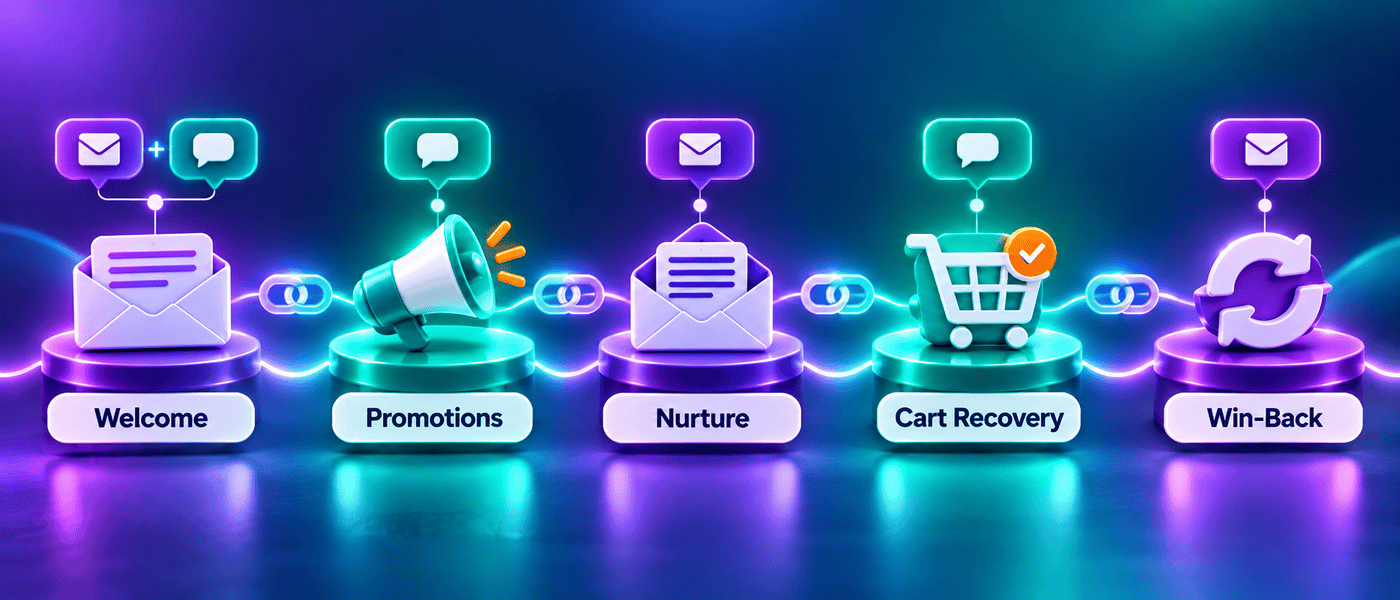
Customer journey showing which channel fits each stage: welcome (email and SMS), promotions (SMS), nurture (email), cart recovery (SMS), and win-back (email)

Match the channel to the moment across the customer lifecycle.

Onboarding and Welcome

Email works well for the onboarding information new customers may need to review more than once. A welcome email can explain what happens next, provide account details, introduce key products or services, and link to useful resources.

SMS can take care of more immediate steps, such as confirming a phone number or reminding someone to complete registration. You can also use it for a time-sensitive welcome offer when the subscriber has opted in to marketing texts. With text message automation, these messages can be automatically triggered by specific customer actions.

Promotions and Sales

Email can introduce a promotion early, show featured products, explain terms, and give customers time to browse. SMS can come later, when a reminder is more useful, such as several hours before the promotion ends.

You might send a detailed sale announcement by email on Friday morning, then send an SMS Saturday evening to opted-in subscribers who have not yet purchased. The text can focus on the deadline and link directly to the offer.

Abandoned Cart Recovery

Triggered abandoned-cart messages can reach customers while the products they considered are still fresh in mind.

A common sequence might look like this:

  • Send an email after the cart is abandoned, showing the items left behind and providing a direct link back to checkout.
  • If the customer does not return, follow up later with SMS, provided the person has separately opted in to marketing texts.

Because abandoned-cart follow-ups depend on timing and customer behavior, automation can help move this sequence along without requiring manual intervention at each step. The performance data suggests those triggered messages can also be highly effective. According to the Omnisend 2026 Ecommerce Marketing Report, automated emails made up only 2% of email sends in its 2025 data but generated 30% of email-driven revenue. Omnisend also found that automated SMS had a 3.8% click-to-conversion rate, compared with 0.9% for scheduled SMS campaigns.

Loyalty and Re-Engagement

Loyalty messages can move between email and SMS depending on what you need to communicate. A short text may be enough to tell a customer that rewards are available or points are about to expire. Email is better suited to explaining program benefits, introducing new offers, or giving an inactive customer more information about what has changed since their last purchase. If a subscriber regularly responds to email but rarely interacts with SMS, start with email. Use the engagement patterns you identified earlier to decide which channel should reach each subscriber first.

For messages where a response would help move the customer forward, EZ Texting two-way texting allows customers to reply directly. That can be useful for questions, confirmations, or other situations where sending someone to a separate channel would add unnecessary steps.

Transactional and Operational Updates

Transactional communication is one situation where email and SMS may reasonably arrive close together. A shipping confirmation, appointment change, or account update can justify an immediate text, while the related email provides the full details or documentation the customer may need later.

What matters is that each message serves a different purpose. If both messages deliver the same information in nearly the same format, one is probably unnecessary. On the other hand, when each channel serves a unique function, closely timed messages can make the update easier for customers to act on and reference later.

SMS Compliance Best Practices

An email subscription should not be treated as permission to send promotional texts, so maintain separate SMS consent records and clearly explain what subscribers are agreeing to receive.

Your SMS program should account for:

  • Consent: Obtain the appropriate permission before sending promotional texts and keep records of how subscribers opted in.
  • Sender identification: Make it clear which business is sending the message.
  • Opt-outs: Give customers a reasonable way to revoke consent and stop future covered messages when they do.
  • Sending hours: Follow applicable federal and state rules governing when marketing texts can be sent.
  • Do Not Call requirements: Check whether federal or state Do Not Call rules apply to your campaigns.
  • Recordkeeping and list maintenance: Keep consent records current, process opt-outs promptly, and account for issues such as reassigned phone numbers.
  • State and industry requirements: Review any state-specific telemarketing laws, carrier requirements, and relevant industry guidance that may apply to your messaging program.
EZ Texting

EZ Texting includes platform and compliance features designed to help businesses manage consent-driven messaging and automated opt-outs as SMS becomes part of a larger marketing program.

Start Building a Combined Email and SMS Strategy with EZ Texting

A coordinated email and SMS program works best when each channel has a clear role and each message gives the customer a useful reason to engage. As you build SMS into your broader marketing program, EZ Texting provides the tools to help you manage the text side of that experience:

  • Contact management: Organize contacts, create groups and segments, and use custom fields to support more targeted SMS campaigns.
  • App integrations: Connect EZ Texting with email marketing platforms, CRMs, and other business tools so contact information can move more easily between systems.
  • Text message automation: Build scheduled and trigger-based SMS workflows for onboarding, abandoned-cart follow-ups, reminders, and other customer journeys.
  • Two-way texting: Give customers a direct way to reply when a campaign calls for a response.
  • SMS reporting and analytics: Track delivery, clicks, responses, opt-outs, and other performance data that can be reviewed alongside results from your email platform.
  • Sign-up forms: Add SMS opt-in opportunities to your website, social channels, or email campaigns to help grow your text subscriber list.
  • Platform and compliance features: Use built-in support for consumer-driven consent and opt-outs to help manage key compliance responsibilities within your SMS program.

With the right SMS tools in place, you can coordinate email and text around the customer journey, giving each channel a clear purpose and reducing unnecessary repetition across campaigns.

Start your free trial to see how EZ Texting can support the SMS side of your email and text marketing program.

Frequently Asked Questions About Email and SMS Marketing Strategy

Create messages specifically for each channel. Email can provide more context and supporting details, while SMS should focus on a concise update, reminder, or action that contributes something useful to the campaign.

Plan email and SMS frequency together, and avoid automatically sending every campaign through both channels. Monitor engagement, email unsubscribes, and SMS opt-outs to identify when total message volume may be too high.

Yes. A small business can start with a few high-value campaigns and use automation to handle recurring or behavior-triggered messages without requiring constant manual management.

Invite email subscribers to opt in separately to SMS through a clearly disclosed sign-up form or other enrollment method, and explain what they will receive by text. An existing email subscription should not be treated as consent to send promotional SMS.

Using both channels does not automatically increase or decrease unsubscribe rates. Relevance, frequency, and unnecessary overlap can influence whether subscribers stay engaged, so monitor opt-outs and unsubscribes across both channels when adjusting your communication plan.

14-DAY FREE TRIAL
Take EZ Texting for a Spin
The easiest way to add SMS to your business. No credit card required.
1,000+ five-star reviews

Join the 230,000+ Who Have Used EZ Texting to Connect with Their Audiences.